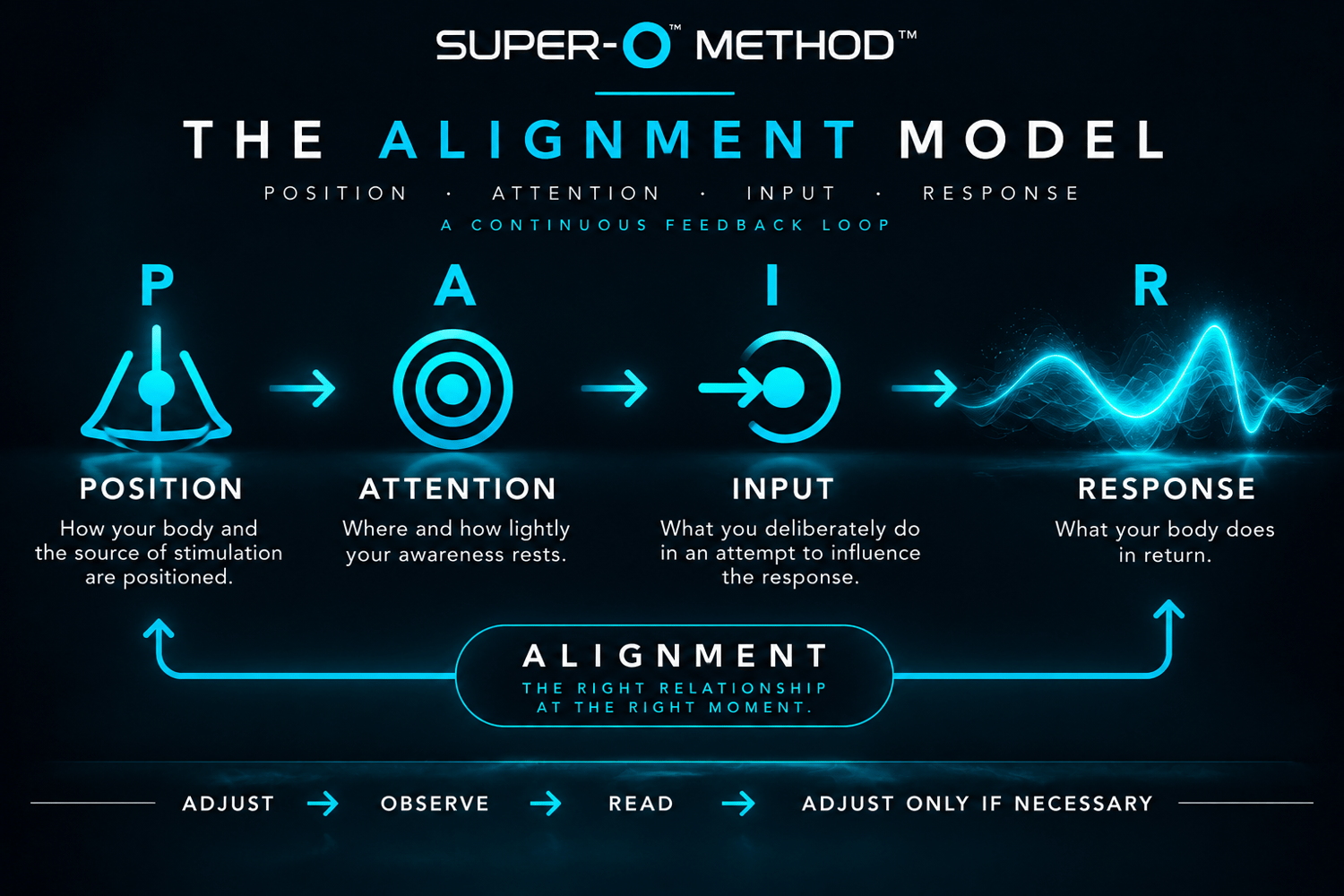
Alignment is not a fixed combination of Position, Attention and Input. It changes as the body's Response develops.
A small contraction might initially reveal a faint sensation, yet become unnecessary once an involuntary rhythm emerges.
Equally, a gentle movement or subtle Input may continue to support that rhythm.
What initiates Response is not necessarily what sustains it.
The skill lies in recognising when to maintain, adapt or reduce your contribution.
DELIBERATE AND AUTONOMOUS ACTIVITY
Deliberate Input and involuntary Response are not necessarily competing forces. They can coexist and even reinforce one another.
A gentle movement may accompany an emerging pulse, while subtle muscular activity may continue without conscious effort.
The distinction is whether your deliberate involvement is supporting, following or overriding what the body is already doing.
As Response becomes more autonomous, unnecessary Input can fall away. This is the essence of non-interference — not complete passivity, but allowing the body's activity to develop without imposing control.
WHEN ALIGNMENT BECOMES INTUITIVE
At first, Alignment may involve consciously exploring Position, Attention and Input while observing how the body responds.
With experience, this relationship can become increasingly natural. Adjustments become subtler, and the need for conscious analysis diminishes.
The aim is not perfect control, but a growing sensitivity to what supports Response.
Ultimately, Alignment becomes less about what you do — and more about how well you work with what your body is already doing.
WHERE TO GO NEXT
Alignment becomes clearer through experience. You can put these principles into practice in Training stage 3: Align, but for now: