Your Cart
Loading

FINDING YOUR SWEET SPOT

The Sweet Spot is where position, contact, pelvic tone and attention combine to make response clearer, easier to recognise and more repeatable.

This page brings together three connected ideas:

Find it. Stabilise it. Let it develop.

WHERE RESPONSE STARTS

The Sweet Spot is where position, contact, pelvic tone and attention combine to make response easier to recognise.

At first, it may be subtle.

You are not looking for maximum intensity.

You are looking for the point where your body begins to answer back.

MORE THAN A LOCATION

The Sweet Spot is not simply one fixed anatomical point.

It emerges when position, angle, contact and pelvic tone come together in a way that makes the response easier to recognise.

That starts with getting the basic geometry reasonably close. A supported position, small changes in pelvic tilt, and the right contact angle can all make a large difference. You do not need perfection — only enough accuracy for the body to begin giving useful feedback.

Then let the pelvis settle.

Slow the breathing. On the exhale, allow the sphincter and pelvic floor to soften rather than brace or squeeze.

Position gets you close. Relaxation helps the signal become clear.

If you need more help with the physical setup, return to the position-calibration work in Training 1 — Prepare.


WHAT YOU’RE LOOKING FOR

Early Sweet Spot signals are often subtle.

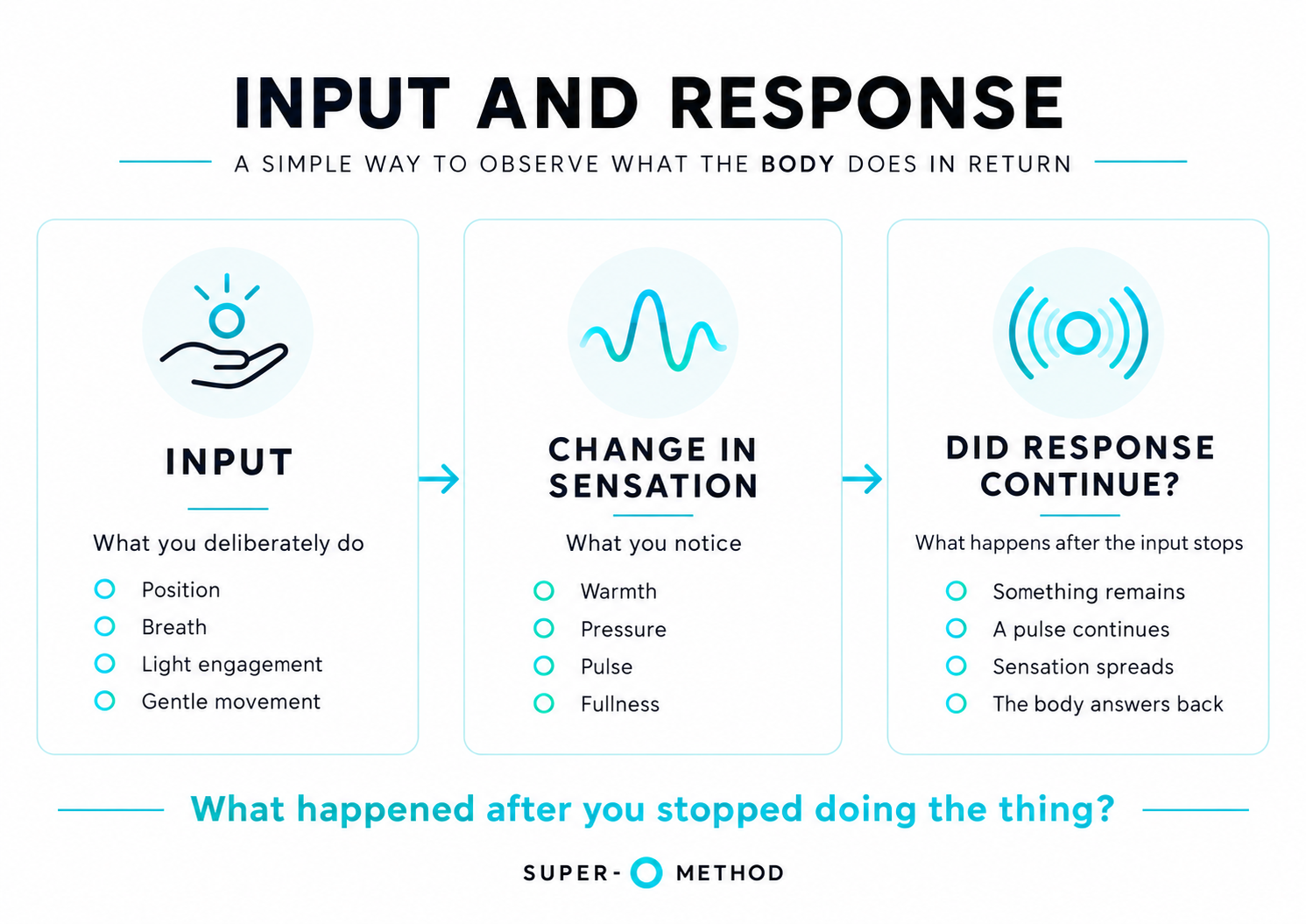
You might notice warmth, pleasant pressure, fullness, tingling, a faint pulse, or simply that one position feels more alive than another.

What matters most is not intensity, but whether the response becomes clearer and more repeatable.

A particularly useful sign is that something continues after the adjustment stops — warmth remains, a pulse carries on, or the sensation seems to have a little momentum of its own.

That is the shift from Input to Response.

WHEN THE BODY ANSWERS BACK

Input can help reveal the Sweet Spot.

But what matters is what the body does after the Input.

The moment something continues on its own, Response has begun.

WHY YOU MAY STILL FEEL VERY LITTLE

Sometimes:

  • Contact is close but not quite held.
  • Full relaxation lets the useful pressure disappear.
  • The pelvic floor is so released that nothing is quite “catching”.
  • The response is simply too faint to distinguish yet.

Crucially:

This does not necessarily mean the position is wrong.

It may mean the signal needs a tiny amount of structure before it becomes recognisable.

That gives baseline tension a reason to exist.


WHAT BASELINE TENSION IS

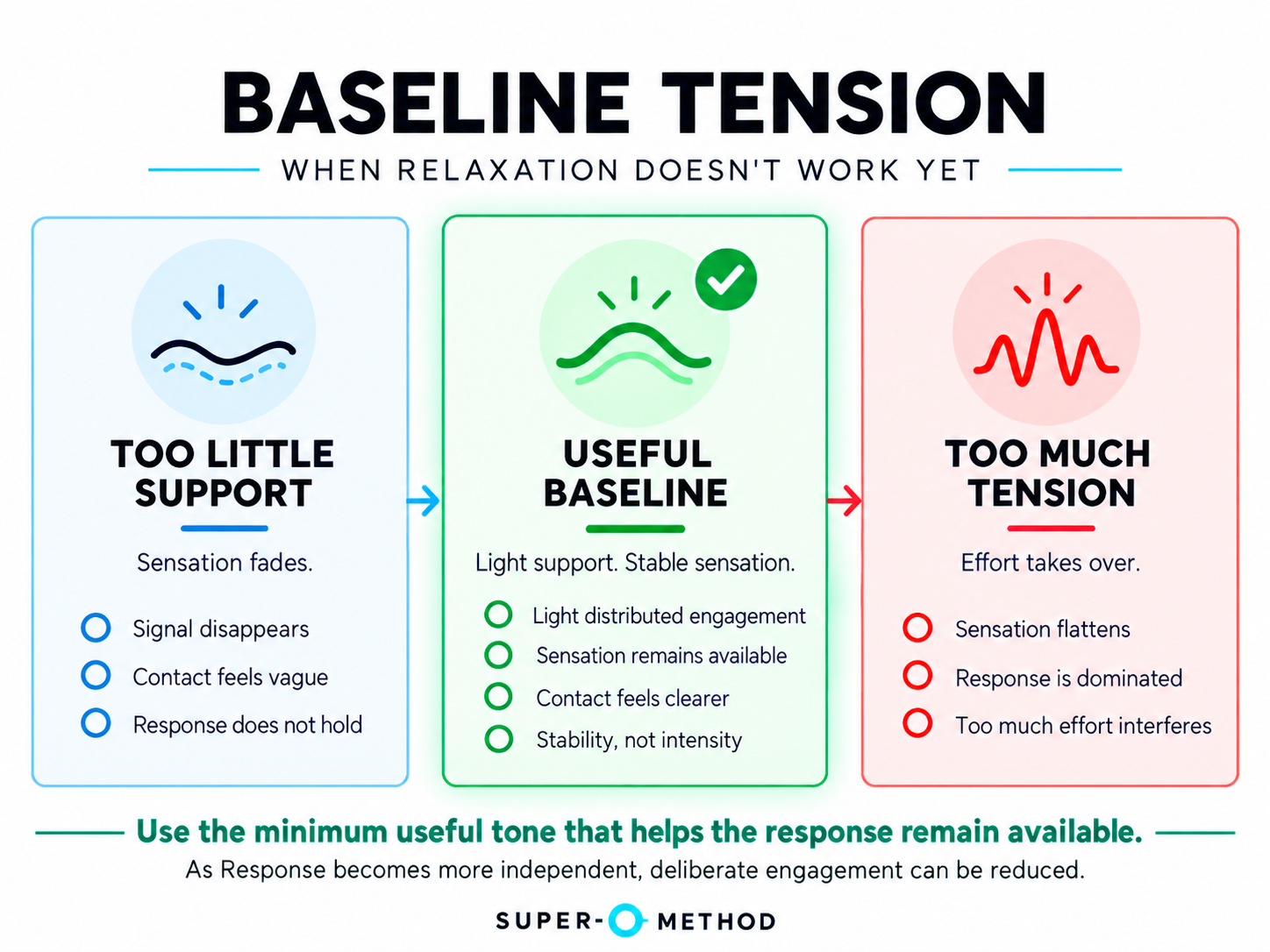
Baseline tension is a very small amount of internal pelvic-floor engagement used when full relaxation makes the Sweet Spot fade.

This is commonly needed during the early phases of training.

Start fully relaxed, then add back the faintest tone through the central pelvic floor and base of the penis — almost as though you are imagining drawing the penis inwards very gently and holding that tension.

There should be no visible clenching or movement.

Use only enough to keep the response clear, then reduce it again as Response becomes more stable.

FIND THE MINIMUM

Too little support and the signal may disappear.

Too much tension can overwhelm it.

Use only the smallest amount that helps the response remain clear.

ONCE THE SIGNAL HOLDS

ONCE IT HOLDS, DO LESS

When the response remains available without deliberate support, begin reducing the Input.

Stay attentive. Notice what changes. But resist the urge to keep adding contractions, adjustments or stimulation.

Once ignition can sustain itself, the default is non-interference.


NON-INTERFERENCE

Non-interference does not mean doing nothing.

You are still paying attention, noticing change and remaining receptive.

You stop directing the response and start listening to it.


IF THE RESPONSE STALLS

Sometimes continued non-interference is exactly right.

But occasionally a very small variation — a slight pelvic rock, tiny shift of a leg or hips, subtle internal change, or even the thought of movement — can alter the signal.

The important part is what happens afterwards.

Introduce as little as possible, then return to stillness and observe.


WHEN RESPONSE TAKES OVER

As the Sweet Spot becomes more stable, you may notice pulsing, contractions, spreading sensation or movement continuing without being deliberately produced.

This is the shift from Input to Response.

When that happens, resist the urge to add more.

Stay attentive, reduce interference, and let Response lead.



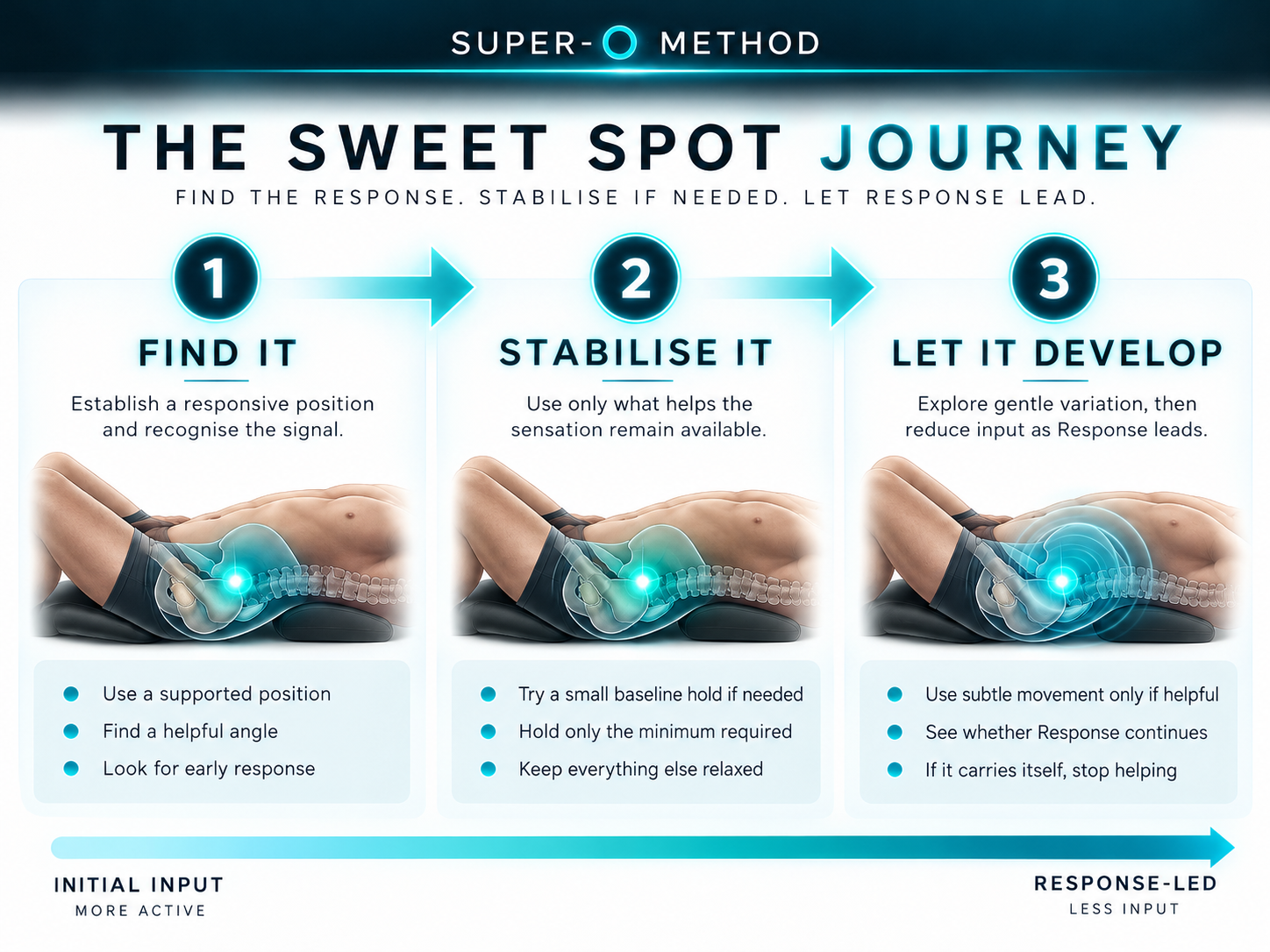
THE SWEET SPOT JOURNEY

Find the conditions where response becomes clear.

Use only enough support to keep it available.

Then reduce Input and let Response lead.

WHERE THIS FITS IN THE METHOD

Finding Your Sweet Spot sits between Detect and Align.

Training 1 — Prepare helps you get the body, position and contact into a workable range.

Training 2 — Detect teaches you to recognise the early signal — the warmth, pressure, pulse or sense of responsiveness that tells you the body is beginning to answer back.

Finding Your Sweet Spot brings those pieces together. It helps you recognise the conditions where the Response becomes clearer, understand when a little support is useful, and know when to stop adding Input.

From there, Training 3 — Align teaches you how to read Response more broadly and refine Position, Attention and Input without overworking the process.

PREPARE → DETECT → FINDING YOUR SWEET SPOT → ALIGN → ALLOW


WHERE TO GO NEXT

Go forward to Training 3: Align

→ TRAINING 3: ALIGN


Go back to Training 2: Detect

→ TRAINING 2: DETECT