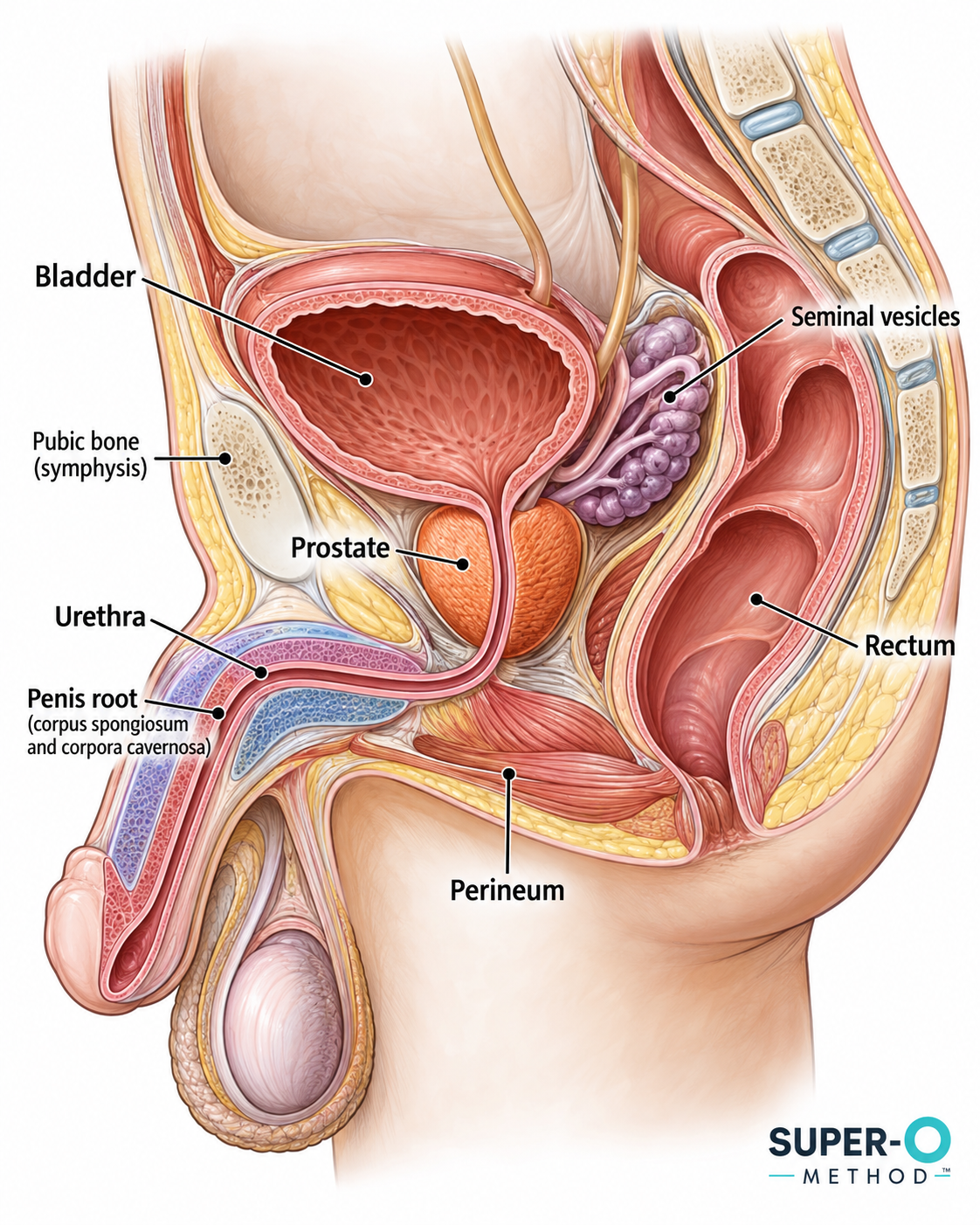
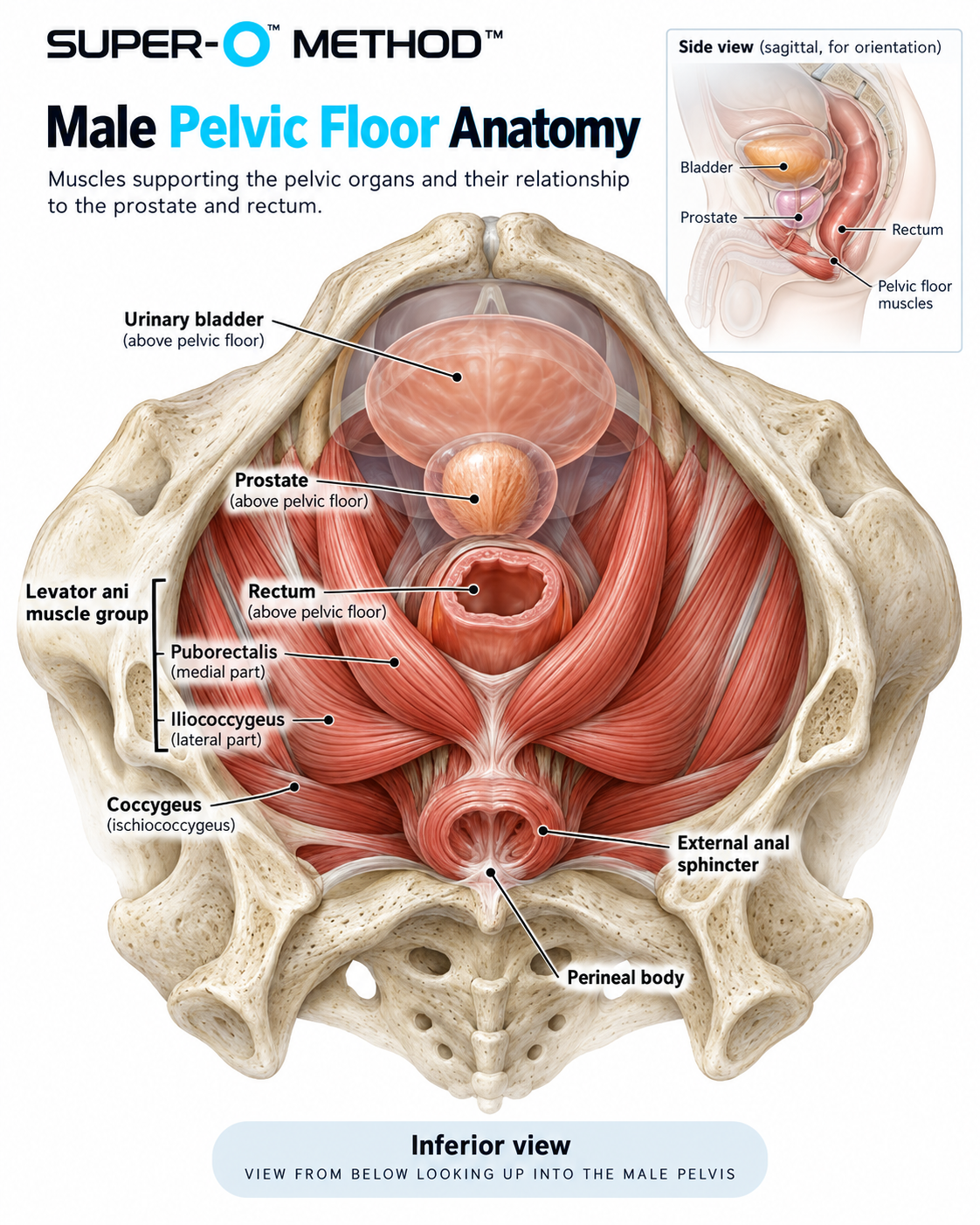
The pelvis contains an extensive network of nerves connecting the prostate, pelvic floor and surrounding organs to the spinal cord and brain.
Three important pathways are:
- Pudendal nerve — carries sensation from the perineum and external genitalia and controls several pelvic floor muscles.
- Pelvic splanchnic nerves — carry parasympathetic signals involved in pelvic organ function and sexual arousal.
- Hypogastric nerves — carry sympathetic signals involved in functions including emission, bladder control and other pelvic responses.
These pathways help explain why prostate-centred experiences can involve sensations and muscular activity beyond the prostate itself.
VOLUNTARY MOVEMENT & INVOLUNTARY RESPONSE
The pelvic floor can contribute to sensation through both deliberate and involuntary muscular activity.
You can consciously engage or release these muscles, changing internal pressure, contact and sensation.
You may also notice contractions, pulses or small movements that occur without deliberately producing them.
The distinction is useful within PAIR.
A deliberate contraction is a form of Input.
An involuntary contraction is something you can recognise as part of your body's Response.
Both can contribute to an experience, and they may overlap.
Sometimes a small deliberate movement is followed by activity that continues after you release.
At other times, sensation fades or changes.
Neither outcome needs to be forced.
The skill is recognising what you are contributing — and what your body is doing in return.
FROM CONTACT TO SENSATION
Physical contact activates sensory receptors in tissues surrounding the prostate and elsewhere in the pelvis.
Signals travel through nerve pathways to the spinal cord and brain, where they contribute to the experience of pressure, movement, warmth or pleasure.
Contact and pleasure are not the same thing. The nervous system interprets sensory information alongside arousal, attention and other influences. Similar physical stimulation can therefore feel very different between sessions.
THE RESONANT BASELINE
As sensitivity develops, some people begin to notice a quiet, persistent background of internal sensation.
This may feel like subtle warmth, gentle pressure, a faint vibration or a sense of activity deep within the pelvis.
Within the Super-O Method, we describe this as the Resonant Baseline.
It is not an orgasm or necessarily a strong sensation. It is a useful description of an underlying responsiveness that may remain present while other sensations rise, fade or change location.
A stronger Response does not always mean a stronger baseline.
Some experiences develop from this subtle background. Others emerge without any clearly recognisable baseline at all.
The important distinction is between sensations that come and go and the quieter activity that may continue beneath them.
The baseline is something to recognise when present — not something to manufacture or maintain through effort.
WHY BODIES RESPOND DIFFERENTLY
Anatomy provides a common foundation, but individual experiences vary considerably.
Differences in tissue sensitivity, pelvic muscle tone, nerve function, arousal and previous experience can all influence how sensations develop.
Some people notice distinct internal contractions. Others experience warmth, pressure, subtle movement or more diffuse sensations.
There is no single physical response that everyone must experience.
THE BODY BEYOND THE PROSTATE
The prostate participates in a much wider system of muscles, nerves and sensory pathways.
During sexual arousal and orgasm, changes may involve breathing, circulation, muscle activity and sensations elsewhere in the body.
Sensation may remain concentrated around the prostate and pelvis, or become more widely distributed through the torso, limbs and other areas. These experiences vary between individuals and can change considerably within a single session.
Where sensation occurs does not determine how advanced the experience is.
These responses do not necessarily occur together or follow a predictable sequence.
Understanding the anatomy helps establish where sensations may originate. How those sensations interact and develop is explored further in THE CIRCUIT which is accessible from The Vault.
THE BODY AND THE METHOD
The Super-O Method does not require precise anatomical knowledge to practise successfully.
Understanding the physical structures can, however, make it easier to recognise what you are experiencing.
Within PAIR, Position, Attention and Input influence the conditions under which Response emerges.
The body provides the physical foundation. The Method helps you learn to recognise and work with its responses.
WHERE TO GO NEXT
Back to Training 1:
If you ever want to do further reading, you'll find interesting pages and articles in: