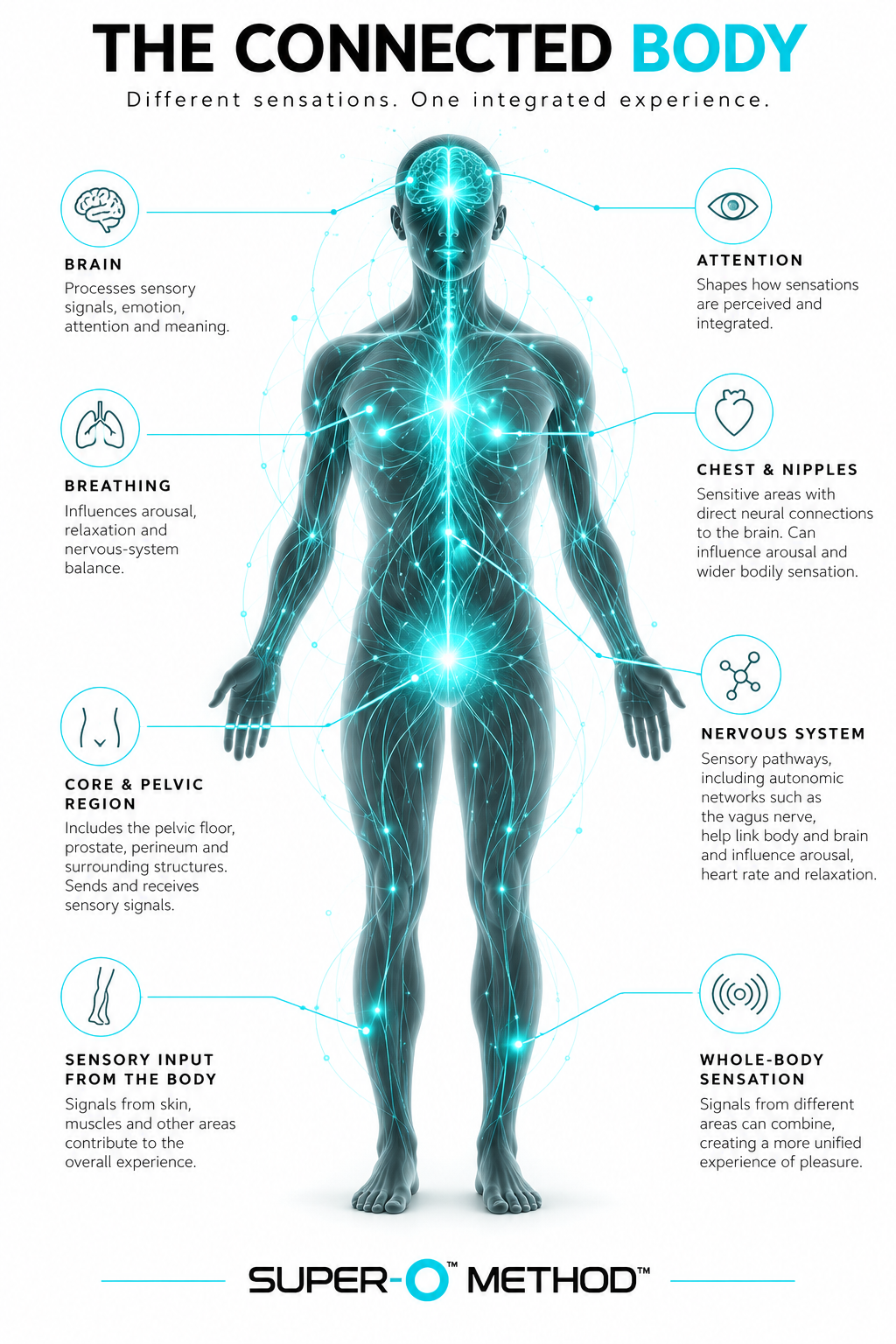
The nervous system connects these different sources of sensation through a complex network of sensory nerves, spinal pathways and brain activity.
But arousal is more than the transmission of signals.
The brain continually interprets what the body is experiencing, while the body's changing state influences what the brain perceives.
This relationship works in both directions.
A subtle pelvic sensation may heighten awareness elsewhere. Changes in breathing, muscular activity or emotional state may alter how pleasure is experienced.
The autonomic nervous system also plays a role, coordinating involuntary bodily responses associated with arousal.
These processes do not operate as one dedicated orgasm pathway. They involve multiple interacting systems.
The important principle is integration: different signals and responses can influence one another, contributing to a single evolving experience of pleasure.
HOW THE CIRCUIT CLOSES
Within the Super-O Method, PAIR provides a way to understand how this interconnected system responds.
Position, Attention and Input create the conditions. Response tells us what happens in return.
But the relationship does not end there.
Response can influence what happens next.
A developing pelvic rhythm may change breathing, draw awareness towards other sensations or be accompanied by involuntary muscular activity.
These changes can, in turn, influence the wider experience of arousal.
This continuing exchange is what we call the Circuit.
It is not a fixed sequence or a single neurological pathway.
It is a feedback relationship in which sensation, awareness and bodily responses continually influence one another.
And sometimes, the most important contribution is recognising that no further deliberate Input is needed.
FROM LOCAL SENSATION TO WHOLE-BODY PLEASURE
Pleasure often begins as something localised.
A feeling of warmth, pressure or movement deep within the pelvis may initially seem separate from sensations elsewhere in the body.
But as arousal develops, the experience can become less confined.
Sensations may spread, overlap or begin to feel connected.
Pelvic pleasure might be accompanied by warmth in the chest, tingling in the limbs, changes in breathing or waves that seem to involve the entire body.
This does not necessarily mean pleasure is physically travelling from one region to another.
Rather, the brain can integrate different sensory and bodily responses into a broader experience.
The distinction between where pleasure begins and where it is felt may become less important.
For some, this integration contributes to the expansive, whole-body quality associated with a Super-O.
The experience is not defined by how many regions become involved, but by how naturally they form part of the same unfolding response.
WHEN THE CIRCUIT BECOMES SELF-SUSTAINING
In the early stages of arousal, deliberate Input may be needed to establish or maintain sensation.
But sometimes, something changes.
The body's own Response begins to contribute more than the Input that initiated it.
Involuntary contractions, developing pleasure waves and changes in bodily awareness may continue with little deliberate involvement.
The experience can begin to feel as though it is unfolding on its own.
This is where non-interference becomes particularly important.
Additional stimulation, muscular effort or attempts to intensify pleasure may interrupt a Response that is already developing.
The aim is not to keep the Circuit moving, but to recognise when it is moving without your help.
This does not mean the Response will continue indefinitely or develop into a Super-O every time.
It means that, for a period, the body's own activity may become the primary driver of the experience.
Input becomes less important. Response takes the lead.
ONE SYSTEM, MANY POSSIBILITIES
The Circuit will not feel the same for everyone.
Some people experience pleasure primarily within the pelvis. Others notice sensations involving the chest, limbs or wider body.
Responses may develop gradually, emerge unexpectedly or vary between sessions.
WHERE TO GO NEXT
The Circuit explains how different sensations and bodily responses can become part of one integrated experience.
The following pages have more to explore.
Understand the anatomy and physiological systems involved in prostate-based pleasure.
Explore how Position, Attention, Input and Response interact — and why their relationship matters.
Discover how familiarity, sensitivity and responsiveness may change through experience.
Learn to recognise when the body's own Response is developing and when less deliberate involvement may help.