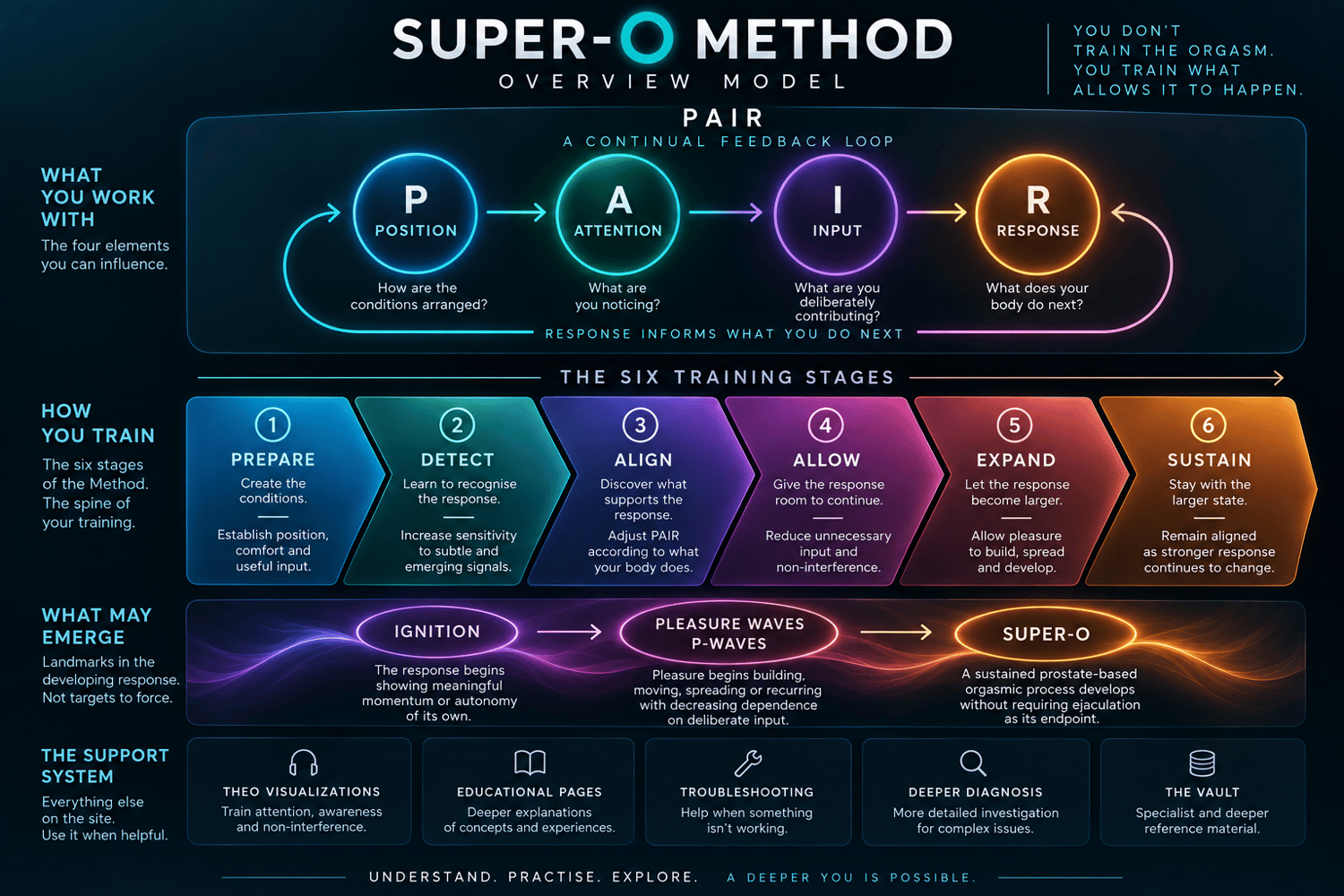
The six stages are arranged in a deliberate order.
Early training involves more conscious contribution: choosing conditions, applying Input and learning to recognise what happens in response.
As Response becomes clearer, the relationship begins to change.
Deliberate contribution → Responsive cooperation → Increasing autonomy
You are not simply learning to do less.
You are learning to respond more intelligently to what your body is already doing.
The question gradually changes from:
“What can I do to make something happen?”
to:
“What does this Response need from me now?”
Sometimes the answer is:
Very little.
THE STAGES ARE NOT LEVELS
The six stages are a training sequence, not a ladder you permanently climb.
You don't complete Prepare and leave it behind. You don't graduate from Detect or stop needing Alignment.
As your practice develops, you may move backwards and forwards through these skills naturally.
- Return to Prepare when conditions don't feel right
- Return to Detect when Response becomes difficult to read
- Use Allow when you notice yourself interfering
- Revisit the basics even during experienced practice
Move forward when it helps.
Move back when it helps.
The stages give your training direction, not prescription.
RESPONSE LANDMARKS
The six stages describe how you train.
Along the way, different kinds of Response may begin to emerge.
Three useful landmarks are:
IGNITION
The point at which Response begins showing meaningful momentum of its own.
Something is no longer happening only because you are deliberately creating it.
PLEASURE WAVES
Pleasure begins to build, move, spread or return in waves, with decreasing dependence on deliberate Input.
These are often called P-waves.
SUPER-O
A sustained, prostate-based orgasmic experience that does not require ejaculation as its endpoint.
These landmarks are not additional training stages and they are not targets you need to force.
You don't complete a particular stage and automatically unlock the next Response.
The training develops your ability to recognise, support and remain with whatever begins to emerge.
Train the conditions. Learn the Response. Let the experience develop.
USING THE WIDER METHOD
The six Training stages are the main route through the Super-O Method.
Everything else exists to support that training, not replace it.
THEO VISUALIZATIONS
Guided experiences for developing attention, patience, body awareness and non-interference.
Use them alongside the Training when you want help experiencing these skills rather than simply understanding them.
→ EXPLORE THEO
EDUCATIONAL PAGES
Deeper explanations of subjects such as Alignment, The Sweet Spot and Position Optimisation.
Follow these when a Training stage points you towards something worth understanding in more detail.
TROUBLESHOOTING
When something isn't working, Troubleshooting helps you identify patterns and make useful adjustments without abandoning the Method.
→ TROUBLESHOOT
THE VAULT
The deeper reference layer of the site.
Explore it when curiosity takes you further, but you don't need to understand everything in the Vault to progress through the Training.
→ EXPLORE THE VAULT
The Training is the curriculum.
Everything else is the support system.
HOW TO USE THE METHOD
If you're starting for the first time, keep it simple.
- Begin with Training 1: Prepare
- Work through the six stages in order
- Practise them rather than simply reading them
- Explore supporting material when it becomes relevant
- Return to earlier stages whenever it helps
There is no timetable for moving through the Method.
Some skills may develop quickly. Others may take considerably longer. Your experience does not need to follow somebody else's schedule.
The Method gives you direction.
Your Response determines the pace.