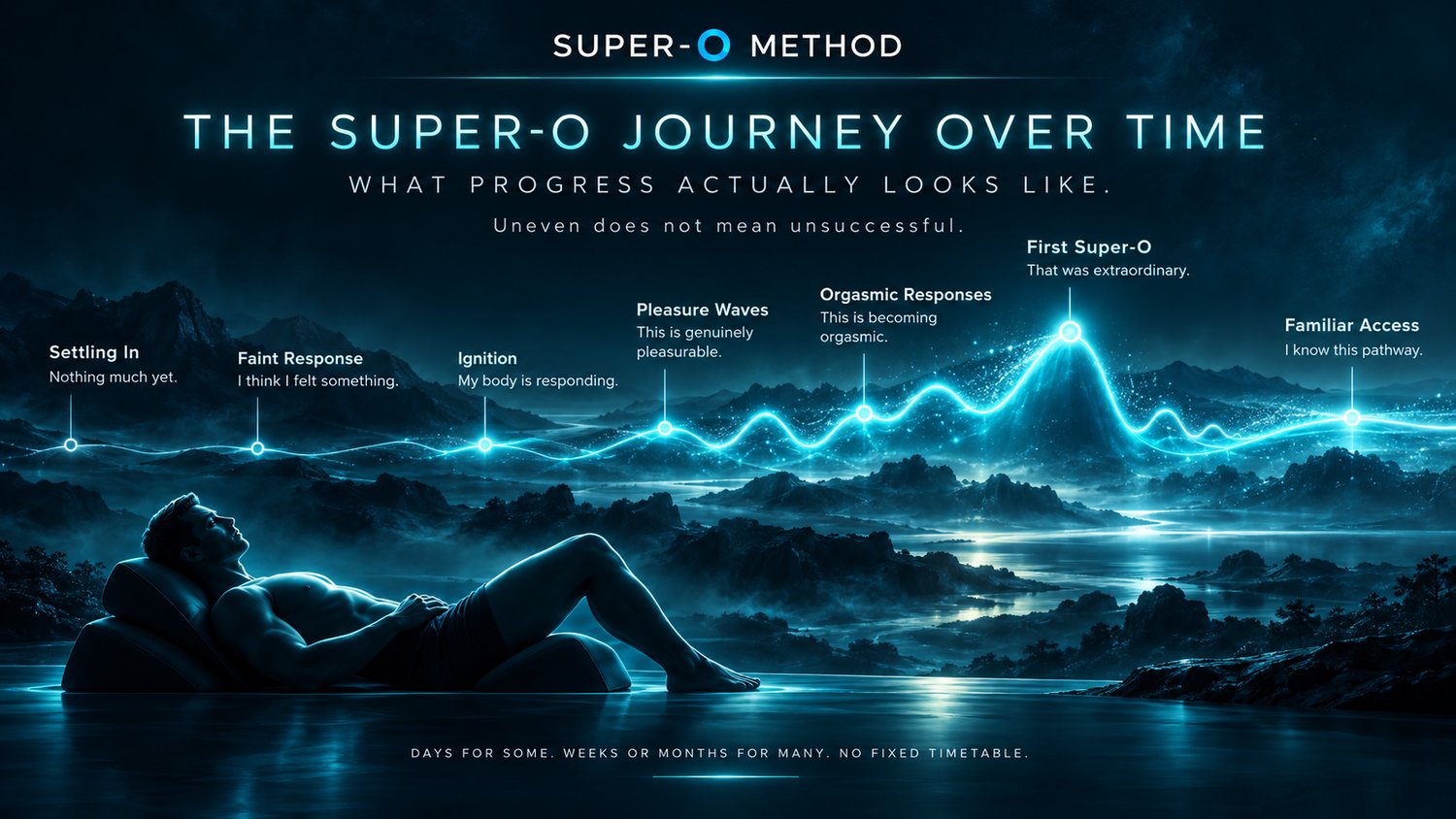
THE SUPER-O JOURNEY OVER TIME
Super-O development is rarely a straight line. For most people, the journey unfolds through quiet sessions, faint signals, growing pleasure, breakthroughs and periods where progress can feel difficult to reproduce.

Super-O development is rarely a straight line. For most people, the journey unfolds through quiet sessions, faint signals, growing pleasure, breakthroughs and periods where progress can feel difficult to reproduce.
A long journey can still be a good journey.
There is no fixed timetable.
Some parts may develop quickly; others may take weeks or months.
What matters is growing recognition, pleasure and familiarity with the pathway.
The sections below explore seven common landmarks that may appear along the journey.
For many people, the first part of the journey is simply getting used to the experience.
You may spend several sessions finding a comfortable Position, learning what internal contact feels like and noticing how much tension or Input you are using.
There may be very little obvious pleasure at first.
That does not necessarily mean nothing useful is happening.
Early progress can simply mean becoming comfortable enough to notice more.
At some point, something begins to stand out.
It may be warmth, pressure, tingling, a small pulse or a fleeting hint of pleasure.
The important change is not intensity.
It is that Response has become detectable.
For some people this happens quickly. For others it takes repeated sessions.
A faint signal matters — but it is usually the beginning of the journey, not the end of it.
Ignition is where Response becomes unmistakably pleasurable.
You may notice involuntary pulsing, repeated pleasure or a sense that the body is beginning to contribute more than deliberate Input alone.
This can feel like a major turning point.
For the first time, you are no longer simply hoping something might happen.
The body is clearly answering back.
Pleasure may begin to rise, fade and return in recognisable waves.
For some people this follows Ignition quickly. For others, it develops gradually over weeks or months.
The experience may still be inconsistent, but the journey itself has changed.
Pleasure is no longer just a possibility.
The practice has become rewarding in its own right.
As Pleasure Waves deepen, they may begin tipping into distinctly orgasmic Responses.
These can take many forms and do not need to be ranked or chased.
You may experience brief dry orgasms, prostate-centred orgasms, repeated orgasmic waves or other intense autonomous events.
Not every orgasmic Response is a Super-O.
There can be a rich and highly pleasurable territory between Pleasure Waves and Super-O.
A first Super-O can arrive surprisingly early, or only after a much longer period of development.
It may feel unmistakably different in scale, duration or intensity from what came before.
But one breakthrough does not automatically create reliable access.
Some people experience a Super-O and then struggle to recreate it.
A first Super-O proves possibility, not consistency.
Over time, the pathway may become less mysterious.
You may recognise early Response sooner, understand when Input is helping or interfering, and become more confident staying with larger waves.
Sessions can still vary.
The difference is that you increasingly understand what the body is doing and how to return to familiar conditions.
What once felt extraordinary can gradually become familiar.
There is no standard timetable.
Some people notice faint Response within their first few sessions. Others need much longer before anything feels clearly different.
Ignition may develop within weeks, or it may take months. Pleasure Waves can follow quickly or emerge much later. P-waves are already extremely pleasurable.
A first Super-O can happen surprisingly early, but early success does not necessarily mean easy repetition. It can also take months or years.
Progress is not measured only by intensity. Earlier recognition, less unnecessary Input, fewer collapses through interference and a clearer understanding of what changed can all matter.
Use timescales for orientation, not as deadlines — and judge the journey across many sessions, not one.
At first, progress may simply mean noticing something that was not there before.
Later, it may mean unmistakable pleasure, sustained waves or increasingly orgasmic Response.
Eventually, the biggest change may be familiarity: recognising what is happening sooner, interfering less and feeling less dependent on any one session proving something.
What begins as uncertainty can become recognition.
What becomes recognisable can become pleasurable.
What becomes pleasurable can become orgasmic.
And what happens once can, over time, become easier to find again.
The Journey describes what development may look like over time.
The six Training stages — Prepare, Detect, Align, Allow, Expand and Sustain — give you a way to work with whatever part of that journey you are currently experiencing.
You do not complete them once and leave them behind. You return to them as your Response changes.
Starting out? Enter the Training at the beginning:
Noticing faint or uncertain Response?
Response appears but feels inconsistent?
Pleasure is emerging but effort keeps interfering?
Pleasure Waves are developing?
Larger Responses are appearing but difficult to sustain or repeat?