TRAINING 2
DETECT
Learn to recognise what your body is already beginning to do.
You have prepared the conditions.
Now the question changes:
What happened when I stopped doing it?
Detect is where you learn to notice the body's Response.

Learn to recognise what your body is already beginning to do.
You have prepared the conditions.
Now the question changes:
What happened when I stopped doing it?
Detect is where you learn to notice the body's Response.
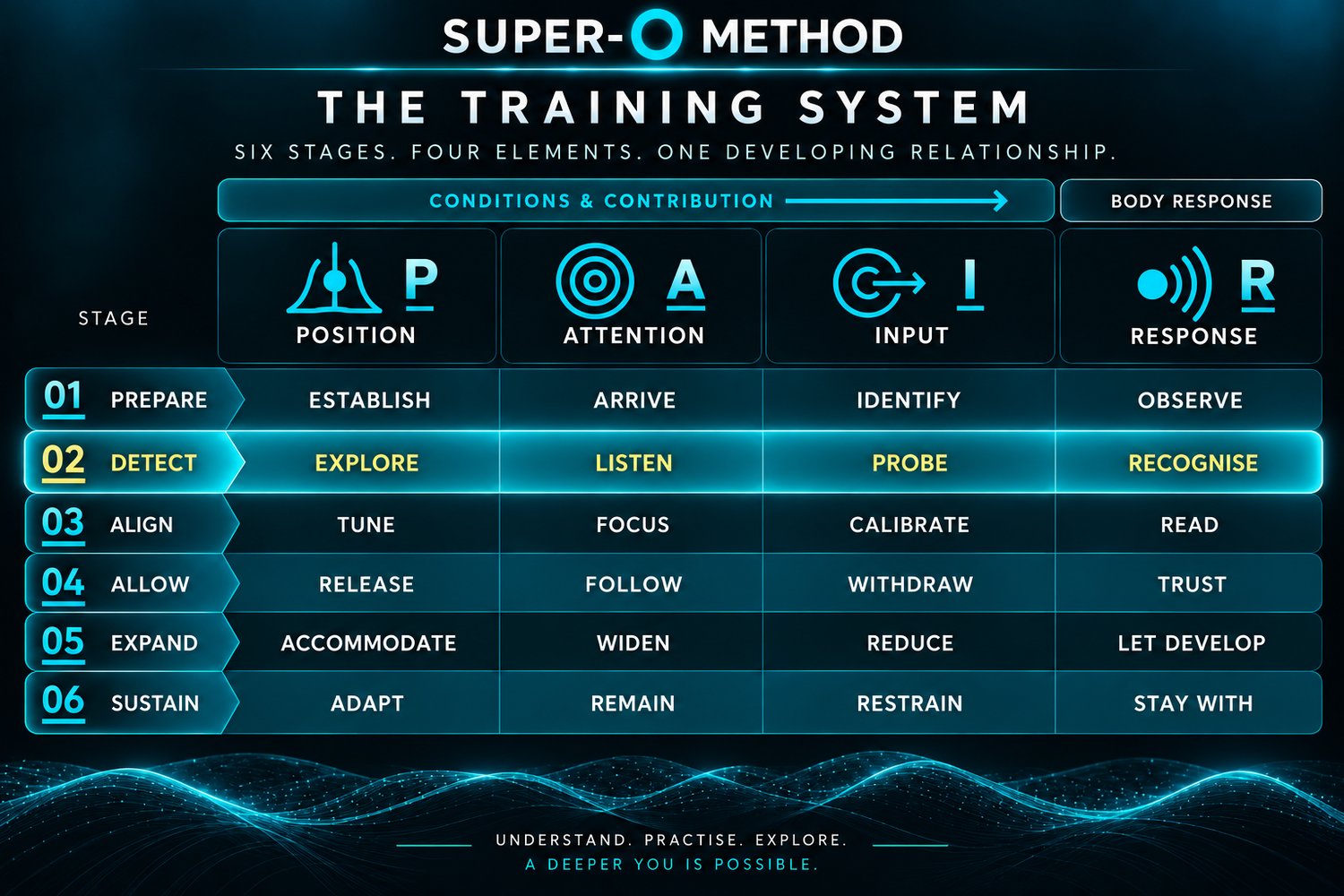
Training 2 develops your ability to recognise Response across PAIR.
For Detect training, begin with one of the positions established in Prepare:
Supported Reclined
or
Side-Lying
Settle into the position and make any obvious adjustments you need.
Then become still.
Notice the pressure, contact, warmth, tension and other sensations already present before you change anything.
You are not searching continuously for a better angle or trying to produce a stronger Response.
You are creating a quiet, stable baseline from which changes become easier to notice.
Want to explore Position and Response further?
Learn how to recognise responsive contact, explore small changes in angle and pressure, and begin identifying the sensations that make your Sweet Spot distinctive.
Settle into Supported Reclined or Side-Lying.
Make any final adjustments you need, then become still.
For a short period, deliberately change nothing.
Notice what is already present:
You are not looking for anything special.
You are learning what baseline feels like before something changes.
That gives you something to compare the next sensation against.
Once you have a baseline, Attention gives you a way to notice when something changes.
The challenge is not simply noticing more. It is noticing without immediately reacting.
Something appears.
You think:
There it is.
Then:
Is it still there?
And perhaps:
Can I make it happen again?
At that point, listening can quickly become doing.
In Detect, practise letting a sensation appear without immediately trying to hold it, strengthen it or reproduce it.
You do not need to decide what it means yet.
Notice it. Let it be there. See what happens next.
Attention is not about monitoring every sensation.
Learn how to recognise meaningful changes, let background sensations remain in the background, and stay receptive without trying to control what happens.
When you notice a change, resist the urge to immediately decide what it means.
Instead, describe what you actually felt.
For example:
Keep the description simple.
You are separating the sensation itself from the story you might build around it.
This makes subtle responses easier to recognise over time without turning every sensation into evidence that something important is happening.
Describe first. Interpret later.
Once you can notice changes, you can begin using Input more deliberately.
In Detect, Input is not about producing the strongest sensation. It is a small probe that gives the body something clear to respond to.
Choose one simple Input — perhaps a gentle contraction, a change in breathing or a small deliberate movement.
Then stop.
The important part is the space that follows:
If you keep changing things, it becomes difficult to tell what caused what.
A small, clear Input followed by stillness makes the distinction easier:
What did I deliberately do?
What happened afterwards?
You are not yet trying to discover the best Input.
You are learning to separate your contribution from the body's answer.
Choose one small, clear Input.
For example:
Before you make it, notice your baseline.
Then make the Input once and stop.
Pay attention to three moments:
BEFORE
What was already present?
DURING
What did the deliberate Input itself feel like?
AFTER
Did anything change, appear or continue once the Input had ended?
There may be nothing obvious. Or you might notice pressure, pleasure, movement, warmth or a second pulse that follows the first.
Don't repeat the Input immediately just to check.
Give the body space to answer.
INPUT → SPACE → RESPONSE
Position, Attention and Input are things you can deliberately change.
Response is different.
Response is what the body does in return.
It might happen immediately, or it might appear after your deliberate Input has stopped. It may be clear or so subtle that you're unsure whether you caused it yourself.
That uncertainty is part of Detect.
You are beginning to ask:
Did I deliberately make that happen?
Did it continue after I stopped?
Did something else follow without me producing it?
You don't need certainty every time.
Over repeated sessions, the distinction between deliberate Input and emerging Response can become clearer.
For now, your job is simply to recognise the difference when you can — and notice the uncertainty when you can't.
Response is not always immediate.
A sensation may appear a few moments after your deliberate Input has ended.
That delay can make the distinction between Input and Response harder to recognise — which is why Detect includes learning to notice what happens next, not just what happens immediately.
When you notice a movement or sensation, don't immediately repeat it.
Wait.
Then ask:
Was that something I deliberately did — or something that happened in response?
Look for clues:
None of these proves that a Response was autonomous.
You are simply gathering evidence and becoming more familiar with the difference between doing and happening.
Sometimes the answer will be obvious.
Sometimes it will be:
I'm not sure.
That's useful too.
Detect does not require certainty. It trains recognition.
Make one small, deliberate Input.
Then stop.
For a short period, resist the urge to:
Simply notice what follows.
If a Response appears, observe it without immediately adding something new.
If nothing obvious appears, notice that too.
The aim is not to make the body respond.
It is to become comfortable giving Response time and space to emerge.
When you notice something interesting, the instinct is often to check it.
You might tighten slightly, focus harder, change your breathing or repeat a movement to see whether the sensation is still there.
But the moment you do that, you have introduced another Input.
There is nothing wrong with checking. The skill is recognising when you have stopped observing and started influencing what happens next.
Sometimes the most useful response to a faint sensation is simply to notice it and leave it alone.
A faint response does not need your help simply because it is faint.
Detect is not a test of whether you can reach Ignition.
If you search only for a strong or unmistakable response, you can miss the smaller changes that this stage is designed to teach you to recognise.
For now, progress is simpler:
Can you notice what changes?
Can you distinguish what you did from what happened next?
Ignition may happen — but Detect does not depend on it.
Some sessions will feel quiet.
You may make an Input, wait, and detect no obvious Response.
That is still useful information.
Detect is not about producing a result on demand. It is about becoming clearer about what you can actually recognise.
A quiet session may tell you that a Response was too subtle to detect, that the conditions were different, or simply that nothing noticeable emerged.
Don't fill the silence by trying harder.
No detectable response is an observation — not a failure.
Detect should make you more sensitive, not more watchful.
If you constantly inspect every pulse, twitch or change in sensation, Attention itself can become another form of interference.
Use the drills to sharpen your awareness, then soften again.
Let sensations come and go without needing to classify every one.
The aim is sensitivity, not hypervigilance.
Sometimes one sensation seems to influence what happens next.
A sensation captures your Attention. That shift in Attention changes what you feel. Another Response follows.
This developing feedback between Attention, sensation and Response can become increasingly important as training progresses.
You don't need to understand or control it yet.
For now, simply recognise that Response does not always happen in isolation.
Want to understand this feedback process further?
Explore how sensation, Attention and Response can begin to interact and reinforce one another.
If Detect still feels uncertain, spend more time with the drills before moving on.
The Further Drills give you additional ways to explore baseline awareness, subtle Response, Input reduction and the distinction between deliberate and body-led activity.
You don't need perfect certainty before progressing.
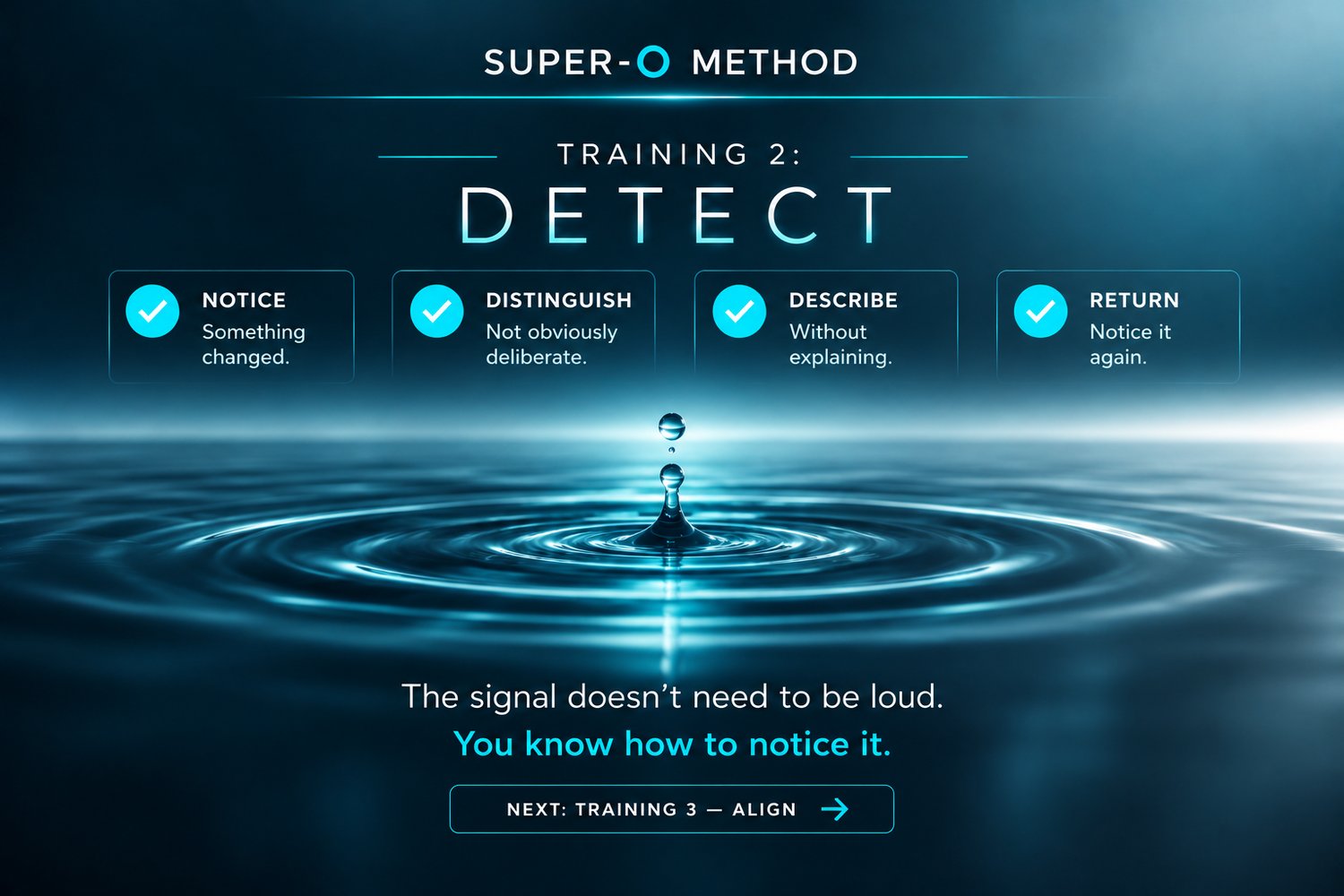
You're ready for Align when you can usually:
If that feels familiar, you're ready to explore which combinations of Position, Attention and Input support the clearest Response.