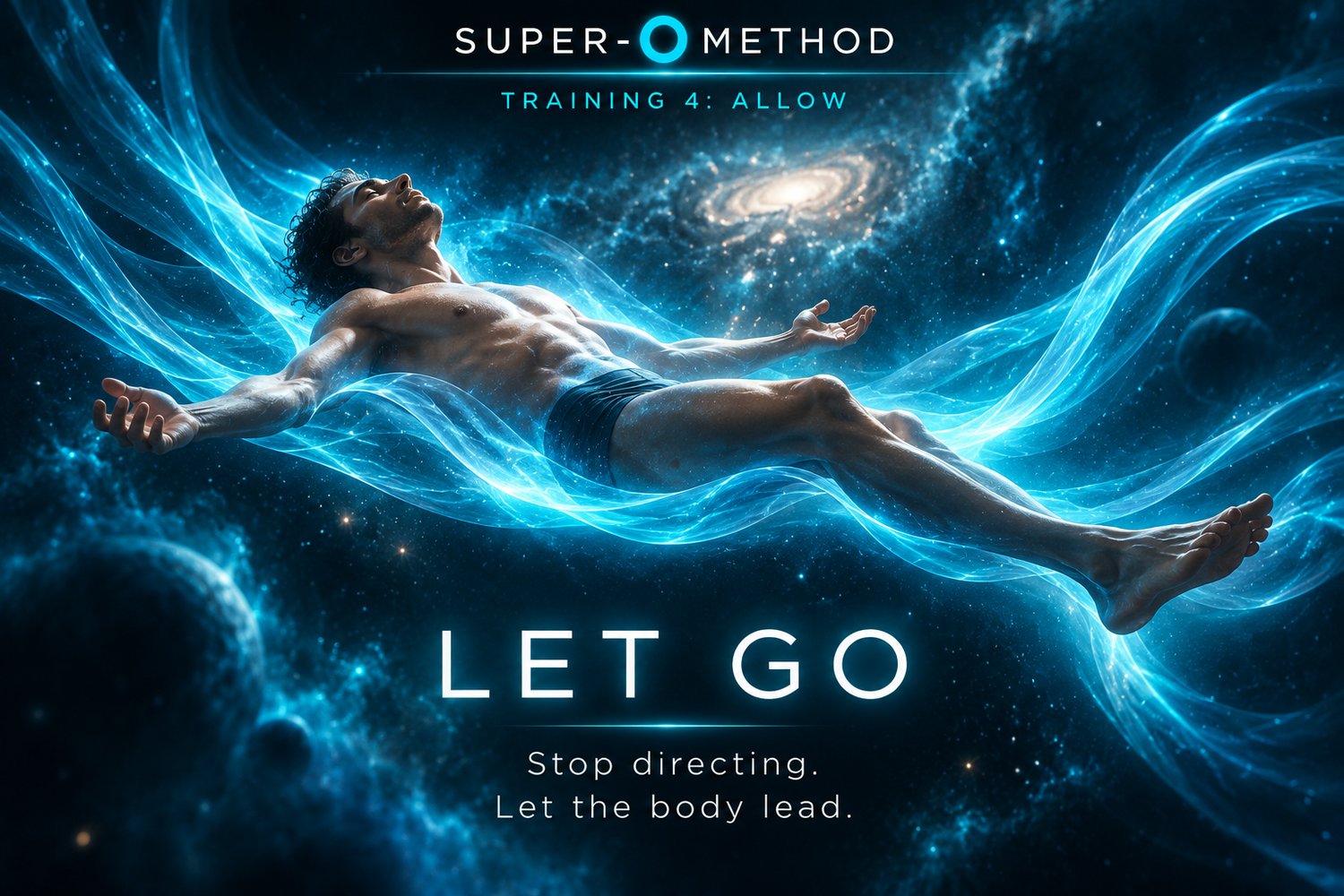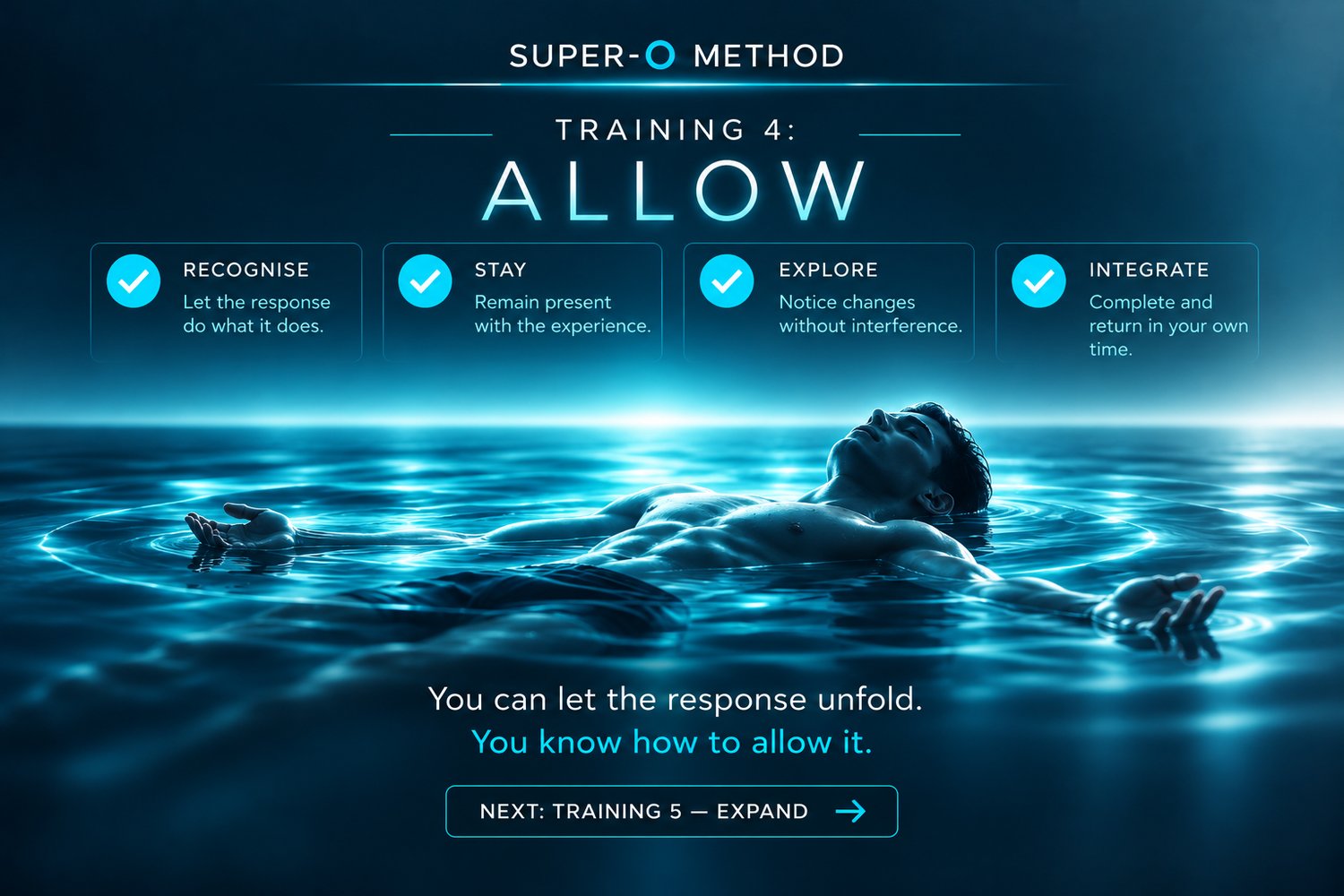
TRAINING 4
ALLOW
When the response begins to carry itself, let it.
You are not trying to do nothing.
You are learning when your input is still useful — and when it is no longer needed.
The body has begun to answer. Give it room to continue.

When the response begins to carry itself, let it.
You are not trying to do nothing.
You are learning when your input is still useful — and when it is no longer needed.
The body has begun to answer. Give it room to continue.
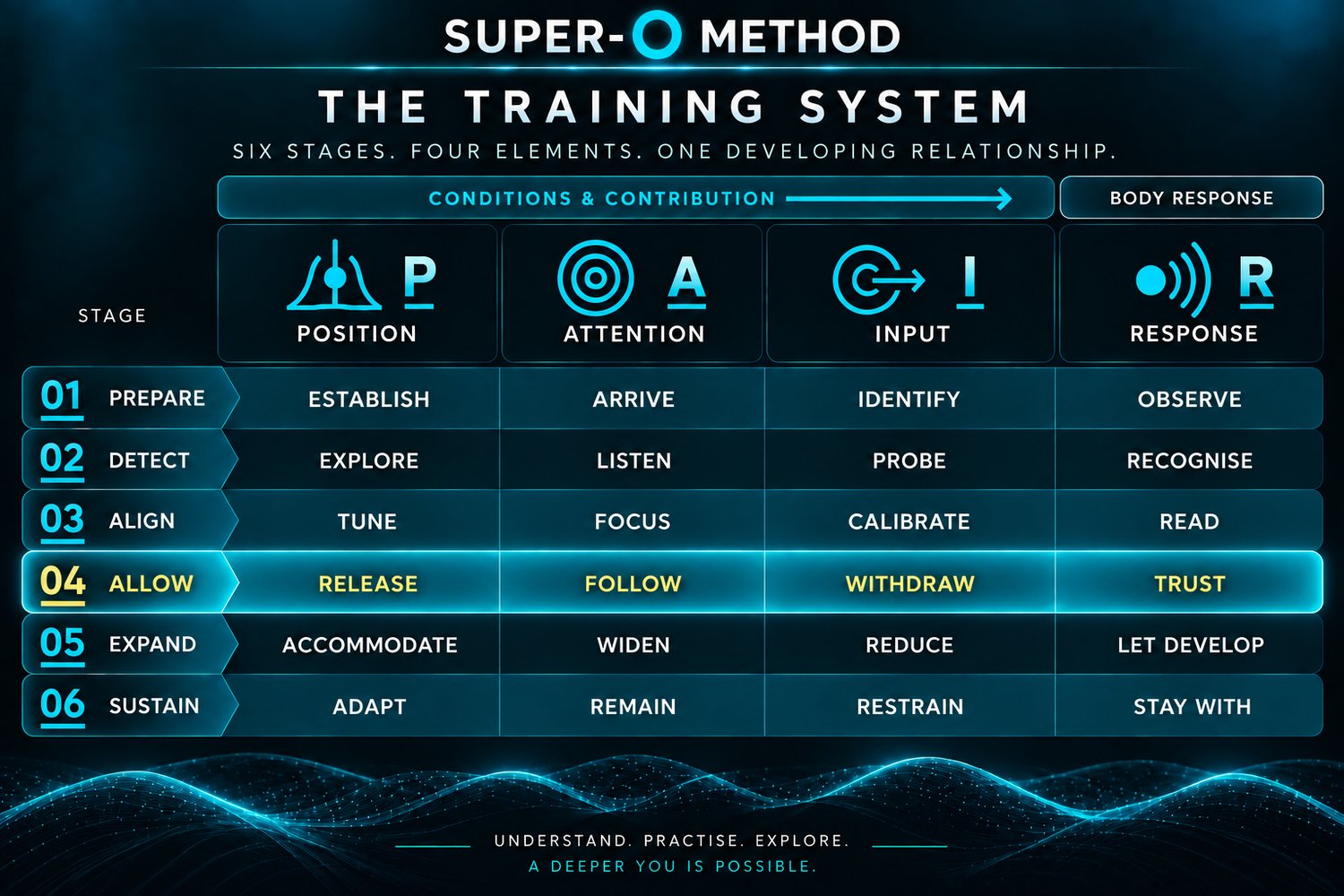
Training 4 develops your ability to allow Response across PAIR.
Settle into conditions that are already working
By now, you should have at least one comfortable practice position from Prepare, and in Align you learned how small positional changes can affect Response.
In Allow, the emphasis changes.
Once your position is producing a recognisable Response, stop trying to improve it.
You may feel an urge to alter your pelvic angle, move your hips or change your support as soon as a sensation weakens. But every adjustment introduces new Input and makes it harder to discover what your body might have done next.
Give the existing position time.
If Response continues, changes or returns without another adjustment, that is useful information.
If nothing happens, you can always make another small change later.
The aim is not to become completely still. It is to stop adjusting when adjustment is no longer necessary.
Allow does not mean holding yourself rigidly in one position.
Comfort still matters. If something feels awkward, strained or distracting, adjust it.
The difference is why you are moving.
Moving because you need greater comfort is useful. Constantly repositioning because you are trying to make the next sensation happen can become interference.
When the conditions feel good enough, let them remain good enough.
A working position does not need constant improvement.
Begin in an established position and allow your body to settle.
Notice whatever Response is available.
When you feel something recognisable, leave your position unchanged for a while.
Resist the immediate urge to improve the angle, increase contact or search for a stronger sensation.
Instead, observe what happens next.
Does the Response continue?
Does it change?
Does it fade and then return?
If nothing develops, make one small positional adjustment, then settle again.
You are training the difference between adjusting to create Response and allowing Response time to answer.
Follow Response without supervising it
In Detect, you learned to notice subtle Response. In Align, you used Attention to compare what changed after an adjustment.
In Allow, Attention becomes lighter.
When something pleasurable begins, it is easy to start checking it.
Is it getting stronger?
Was that another pulse?
Is this going where I want it to go?
How does this compare with last time?
That kind of monitoring can pull you back into deliberate control.
Instead, stay with what is actually happening. Notice the sensation without requiring it to become stronger, repeat itself or develop in a particular direction.
If Response changes, follow the change.
If it becomes quieter, let it become quieter.
If it moves somewhere unexpected, let your Attention move with it.
Stay interested in Response without demanding progress from it.
There is a subtle difference between observing Response and continually checking whether it is working.
The first keeps you connected to the experience.
The second turns the experience into a task.
You do not need to stop thoughts appearing or maintain perfect concentration. Simply notice when Attention has shifted from experiencing what is happening to evaluating what should happen next.
Then return to the Response already present.
Follow the experience. Don’t manage it.
Begin when you have a recognisable sensation or Response.
Let your Attention rest lightly with it.
Notice any urge to measure its intensity, compare it with another experience or anticipate what should happen next.
When you catch yourself checking, return to the sensation itself.
Do not try to strengthen it.
Do not try to hold it in place.
Simply notice what it does next.
You are training Attention to remain present without turning Response into a performance.
As sensation intensifies, the urge to intervene can become stronger.
Explore how to remain present, recognise unnecessary effort and allow your body's Response to develop without trying to control it.
Discover what you can stop doing
Earlier in training, deliberate Input helped you explore Response.
A contraction, small movement, change in pressure or other deliberate action may have helped a sensation appear or become clearer.
In Allow, you begin asking a different question.
Does this Response still need the Input that started it?
When something pleasurable happens, the natural instinct is often to repeat whatever you were doing. Sometimes that is useful. But sometimes the body has already begun contributing its own activity.
If you continue supplying every contraction or movement, it can become difficult to tell the difference.
Allow gives you permission to experiment with less.
Not because less Input is always better, but because reducing it reveals what the body is doing for itself.
Think of Input as a nudge, not an engine.
There is no precise moment when deliberate Input should stop.
The handover may happen gradually.
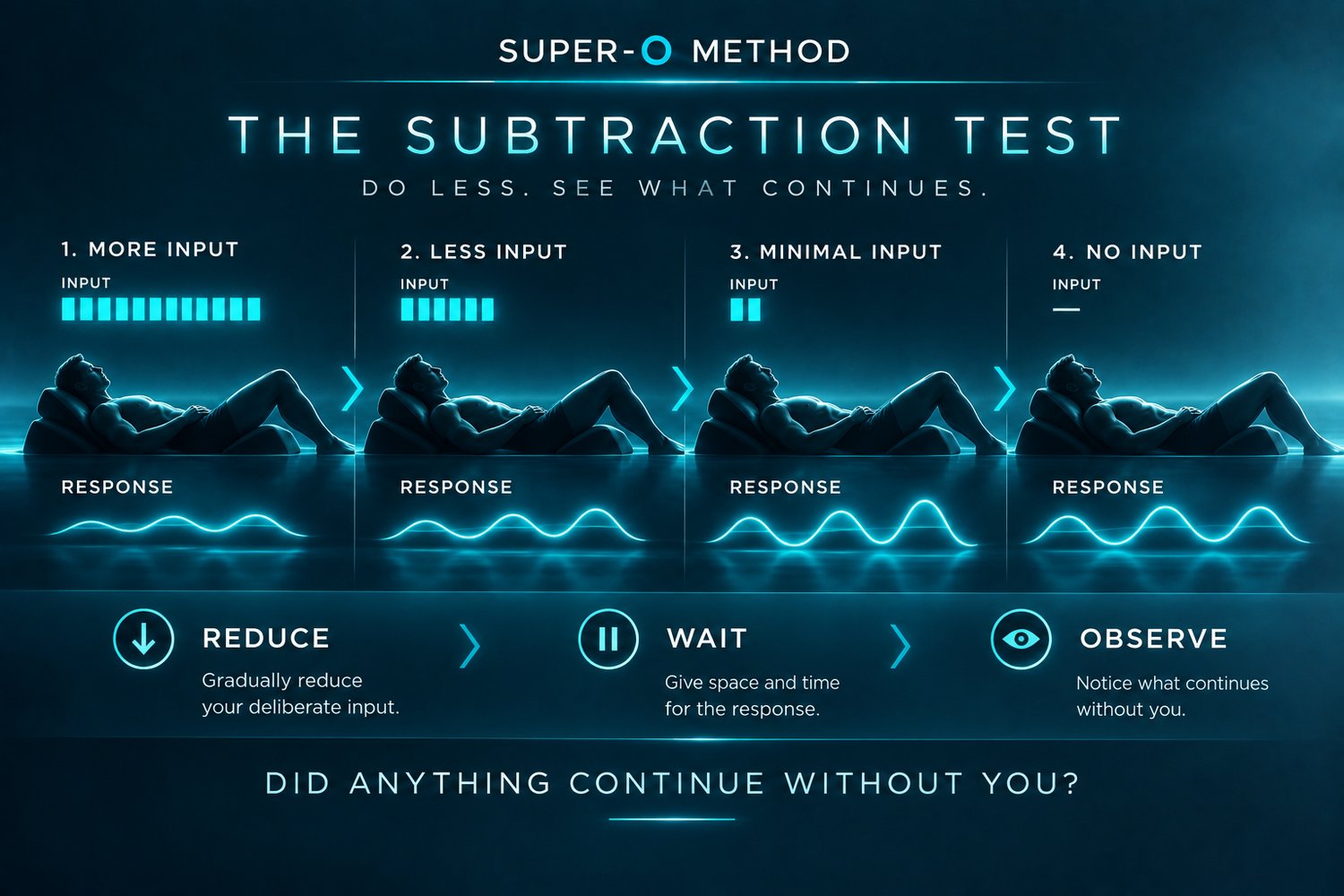
You might reduce a contraction and discover that a pulse continues. You might stop moving and notice another sensation arrive several seconds later. Or you might reduce Input and find that Response disappears.
All three outcomes tell you something.
If Response continues, give it space.
If it fades, wait before deciding what to do next.
If nothing returns, introduce one small Input and observe the Response again.
The aim is not zero Input.
The aim is to discover how much Input the Response actually needs.
Begin with the gentle Input that helps establish a recognisable Response.
Once Response appears, reduce your Input slightly and wait.
If Response remains, reduce Input again. If it fades, wait before introducing one small Input and observing again.
The aim is not zero Input. It is discovering how much Input the Response actually needs.
Let the body answer
Response is different from the other elements of PAIR.
You can change Position, direct Attention and vary Input. Response is what your body does in return.
In Allow, you begin giving that Response more opportunity to participate in what happens next.
A pulse may repeat without another contraction. A sensation may continue after Input stops. Something may fade, change character or return after a quiet period.
You do not need to reproduce each sensation yourself.
Notice what the body adds to the experience.
Response does not always develop in a smooth progression.
There may be pulses followed by quiet. A sensation may weaken before returning differently. Sometimes nothing returns at all.
The important skill is resisting the assumption that every pause requires immediate action.
When Response fades:
A pause gives you information too.
You are learning to give Response enough time to reveal what it can do.
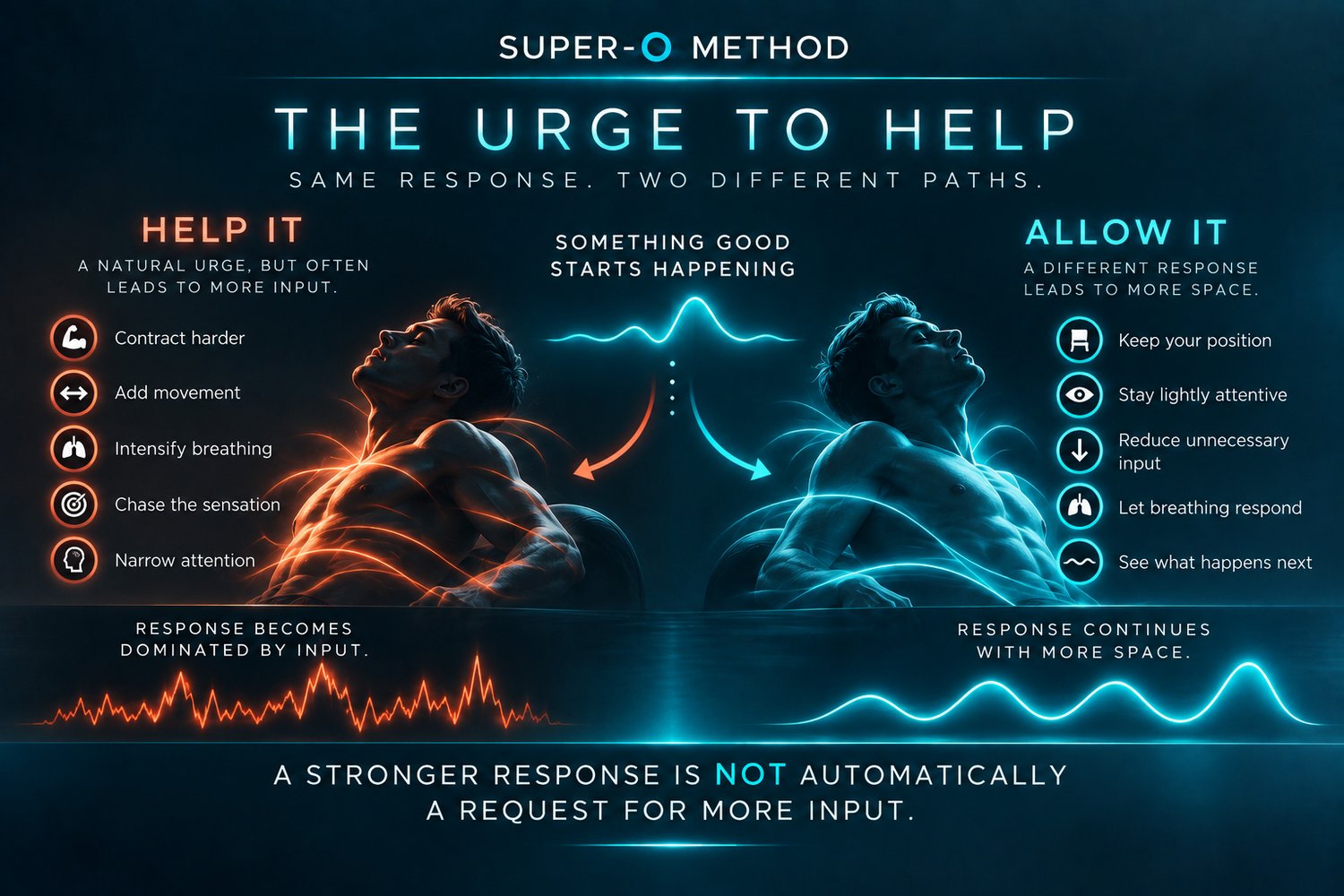
When something good starts happening, the instinct is often to do more — contract harder, add movement or increase stimulation.
But a stronger Response is not automatically asking for more Input.
Sometimes the most useful choice is to leave it alone and see what happens next.
Success is often the moment to consider interfering less.
At some point, you have to stop trying to make it happen.
Notice how often you are still helping — contracting, adjusting, checking, anticipating, trying to hold onto pleasure or pushing towards what you hope comes next.
If the body is responding, let it have the experience. Submit to the Response rather than continually directing it.
You can remain present without being in charge.
Progress in Allow is not measured by how intense the session becomes.
You are looking for signs that you are contributing less while remaining connected to Response.
These may be small moments at first. That is enough.
Allow is not about producing less. It is about interfering less when the body is already responding.
If Allow still feels difficult, spend more time with the drills before moving on.
The Further Drills give you additional ways to practise reducing unnecessary Input, leaving pauses unfilled, recognising the urge to intervene and giving Response more opportunity to continue without your help.
You don’t need to master Allow.
If you can recognise when Response begins to continue without your help, reduce unnecessary Input and resist the urge to keep directing what happens next, you have enough to continue.
You are learning to settle, follow, withdraw and trust — giving your body more opportunity to lead.