TRAINING 5
EXPAND
GIVE THE RESPONSE ROOM TO GROW
Pleasure may spread, connect, rise and fall, or continue with less deliberate Input.
Expand is about staying aligned as that process develops.
Support what is happening without trying to take it over.

Pleasure may spread, connect, rise and fall, or continue with less deliberate Input.
Expand is about staying aligned as that process develops.
Support what is happening without trying to take it over.
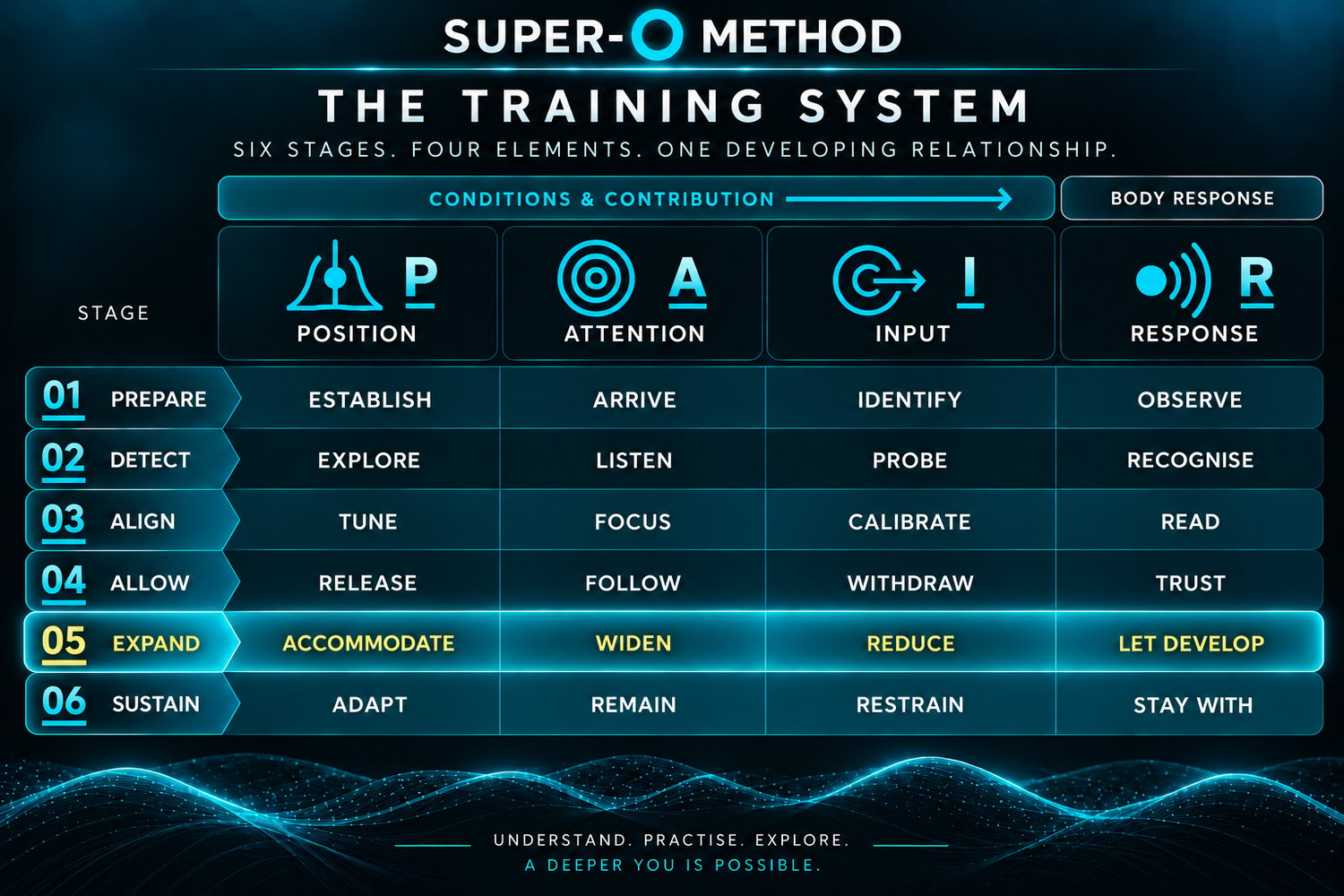
Training 5 teaches you to stay aligned as Response begins to develop and contribute more for itself.
Let Position accommodate a developing Response.
By now, you should have at least one comfortable practice position and understand how small changes can affect Response.
In Expand, the emphasis shifts. Rather than continually tuning Position, you begin allowing it to accommodate what Response is becoming.
As Response develops — sometimes into the beginnings of a pleasure wave, or P-wave — sensation may spread beyond the original area. Your pelvis may shift, your legs may relax or your body may make small spontaneous adjustments.
You do not need to prevent these movements simply to preserve the original position.
At the same time, resist repositioning simply because you want to make the sensation stronger.
Allow movement that seems to accompany the Response. Be more cautious of movement introduced to chase or intensify it.
If contact deteriorates, discomfort develops or Position is clearly interfering, make one small adjustment and notice what happens next.
As a P-wave develops, the experience may remain relatively local or begin to spread through more of the body. Position needs enough stability to support the Response, but enough freedom to accommodate where it goes.
You may find your body uncurls slightly as sensations spread. Your pelvis may shift, your legs may relax, your chest may open or your body may make other small spontaneous adjustments.
Allow movement that seems to accompany Response rather than trying to hold the original position.
Gentle rocking can also support this. Think millimetres rather than centimetres — tiny movements that follow what is happening rather than trying to create more stimulation. Sometimes even the intention or imagination of movement, without visibly moving at all, may be enough.
The distinction is whether you are moving with Response or trying to make Response happen.
If movement becomes larger or more deliberate because you are chasing intensity, reduce it and see what remains.
Give the P-wave stability, but give your body permission to move with it.
Once Response is developing, stay with your established Position.
Allow your body to settle, then explore the smallest possible movement — a slight pelvic rock, a tiny release through the hips, or even simply the intention to move.
Think millimetres, not centimetres.
Notice whether Response continues, spreads or changes. If movement begins to feel like deliberate stimulation, make it smaller or stop and observe what remains.
The aim is to discover how little movement is needed to accommodate a developing P-wave.
Let Attention expand with the P-wave
As Response develops, pleasure may begin to move beyond the original sensation. This is where the first recognisable pleasure waves — P-waves — may begin to emerge.
They do not always arrive in the same way.
A wave may begin as something faint that gradually spreads. It may arrive suddenly and strongly. You might feel sensation move up through the pelvis and spine, travel down into the legs, or spread through the upper body and out towards the hands and fingers.
Sometimes it remains much more local.
The important point is that there is no route the wave has to follow.
If Attention remains tightly fixed on the prostate or the sensation where the wave began, you may miss much of what Response is becoming.
Let sensation lead. Let Attention widen with it.
The progression from the earlier training is simple:
Detect: Can I feel Response?
Align: What helps Response become clearer?
Allow: Can I leave Response alone?
Expand: Can I follow Response as it develops and spreads?
Begin with the clearest part of Response.
As sensation begins to develop, allow your Attention to include the surrounding area and then whatever other parts of the body naturally become involved.
Do not search ahead. Let sensation arrive first.
If the P-wave becomes faint, narrow Attention towards the clearest remaining sensation. If it develops again, widen with it.
Repeat this naturally as the Response changes:
Narrow → Connect → Widen → Follow
The aim is to let Attention follow the P-wave without deciding where it should go.
Let the P-wave do more of the work
When a P-wave begins to develop, the temptation is often to add more Input.
You may contract harder, increase movement, add pressure or try to repeat whatever seemed to start the wave.
But the Response may already have enough.
In Expand, you begin recognising when Input has done its job and giving the developing Response more opportunity to continue for itself.
This does not mean eliminating Input. A small contraction, release, micro-movement or change in pressure may still support what is happening.
The question simply changes:
How little Input does this Response need from me?
As the P-wave becomes more self-sustaining, allow your contribution to become smaller.
Support when needed. Reduce when Response can carry itself.
When pleasure begins to build, notice what you instinctively want to add.
Perhaps you want to contract harder, increase movement, add stimulation or focus more intensely.
Instead, try one less.
Soften the contraction. Make the movement smaller. Delay the extra stimulation. Give Response a little more space before doing anything else.
Then observe what happens.
If the P-wave continues, spreads or develops, leave it alone.
If it genuinely needs support, introduce the smallest useful Input — then reduce again.
The aim is not zero Input. It is discovering how little Input the developing Response actually needs.
Give Response time to become something more
By Expand, Response may be contributing increasingly to its own continuation.
A pulse may become rhythmic. Separate sensations may connect. A P-wave may spread, strengthen, fade and return. Involuntary contractions may become more organised, sometimes with very little deliberate Input.
Your role is not to decide what should happen next.
Instead, notice what Response is already doing and give it enough time to develop before intervening.
Expansion does not always mean becoming stronger. Response may become broader, more connected, more rhythmic or simply continue for longer.
And it does not have to develop into a P-wave every time.
The question is no longer:
What can I do to make this grow?
It becomes:
What happens if I let this develop?
As pleasure develops, sensation may remain deep within the pelvis, spread through the torso or appear in other parts of the body.
It may move, fade, return or become more widely distributed.
There is no correct direction and no particular region you need to reach.
The aim is to remain receptive to the Response that is developing, rather than trying to direct where it travels.
When a clear Response appears, resist deciding what it should become.
Stay with your Position. Let Attention follow. Keep Input minimal.
Then simply observe.
Does the Response spread? Become rhythmic? Rise sharply? Fade? Move somewhere unexpected? Return after becoming quiet?
Try not to correct any of those changes simply because they are different from what you expected.
Give Response permission to change its shape.
The aim is to experience development without directing the outcome.
Let Response show you what comes next.
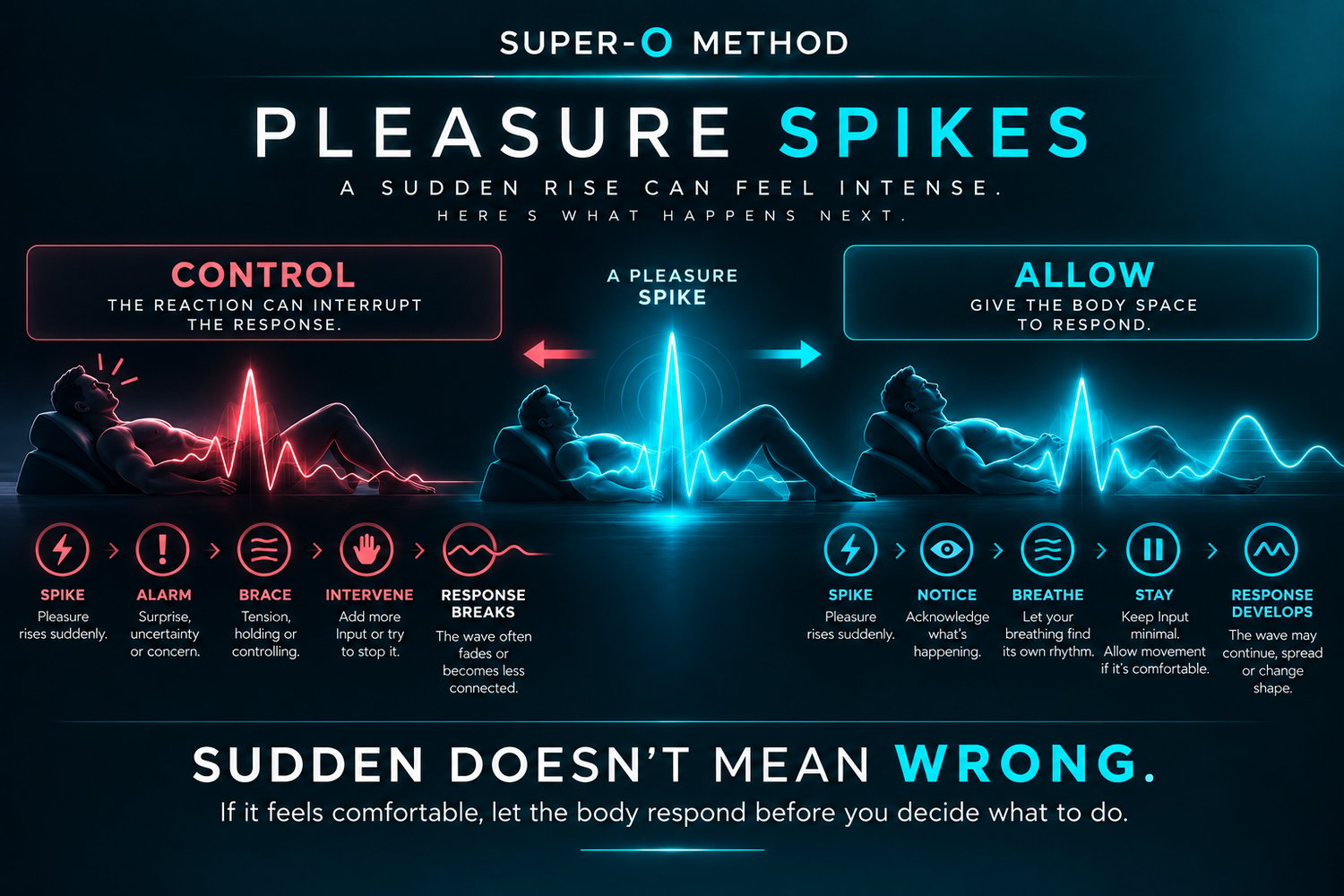
As P-waves develop, pleasure can sometimes rise dramatically and without warning.
Breathing may change, the body may move, and involuntary contractions may become stronger.
If it remains comfortable, acknowledge the change without immediately reacting.
Let breathing find its rhythm and resist trying to intensify, preserve or suppress what is happening.
Give your body room to show you what comes next.
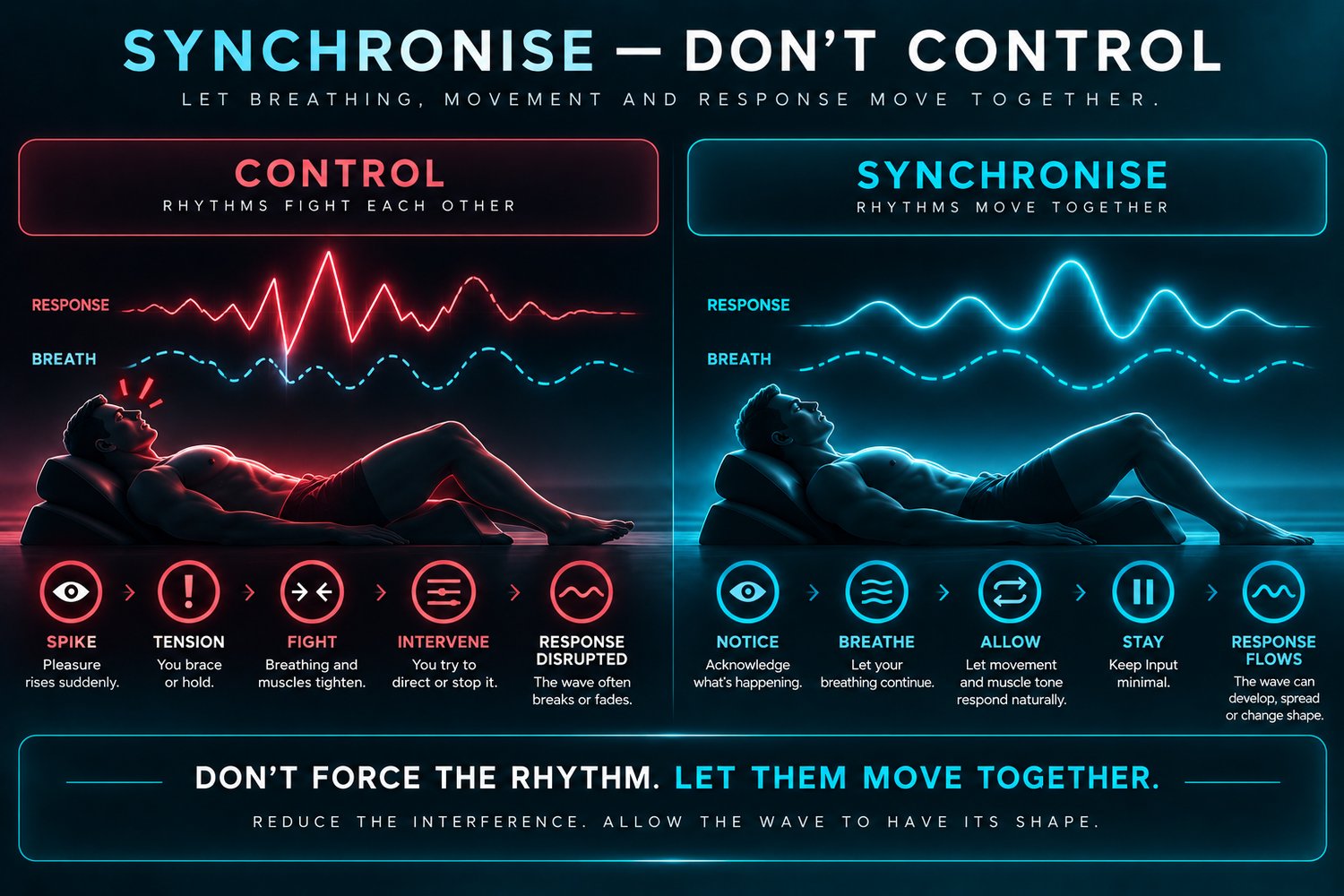
As a P-wave develops, breathing, muscle tone and movement may change with the Response.
You do not need to coordinate them or impose a rhythm.
If you notice yourself bracing, soften and let the body respond naturally.
Don’t force the rhythm. Let them move together.
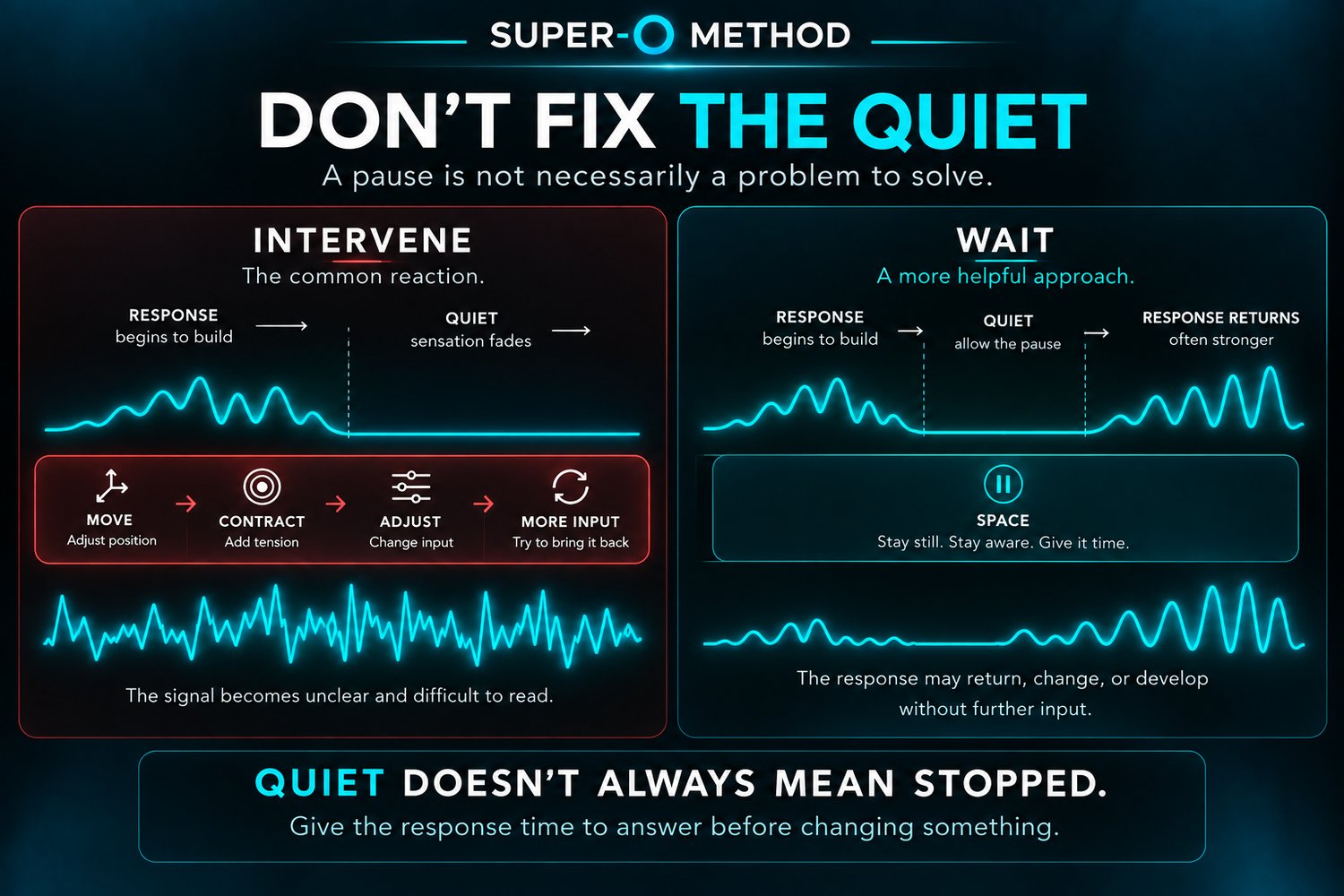
A P-wave may rise, fade and become almost still.
The instinct can be to do something to bring it back.
Instead, stay aware of whatever Response remains and give it time.
Quiet doesn’t always mean finished.
Another wave may return — or the Response may develop in a completely different way.
Response will not develop in exactly the same way every time.
One session may produce strong P-waves; another may remain subtle, local or quiet.
Avoid compensating by adding more Input simply because today feels different.
Work with the Response that is available now — not the one you remember.
Expand is about giving this Response room to develop, wherever it goes.
If you want to spend more time with Expand before continuing, the Further Drills give you additional ways to explore developing P-waves, changing intensity and staying with Response without taking control.
You don’t need to produce strong P-waves or make Response expand every time.
If you can recognise when Response is developing, give it room to change and stay with it without immediately adding more Input, you have enough to continue.
The next stage explores what happens when Response becomes established enough that your challenge is no longer helping it develop — but staying with it for longer.