TRAINING 6
SUSTAIN
Sustain is the skill of staying with what is already happening.
Let Response rise, fall, quieten and build again without chasing the peak.
Contribute when useful. Soften when you can.
When Response can carry itself, let it.

Sustain is the skill of staying with what is already happening.
Let Response rise, fall, quieten and build again without chasing the peak.
Contribute when useful. Soften when you can.
When Response can carry itself, let it.
Training 6 develops your ability to stay aligned as Response continues and changes.
By Sustain, you are no longer searching for the perfect position.
You are learning to preserve what is working while allowing the body to change.
As Response strengthens, your body may shift, tremble, tighten, soften or move naturally. These changes do not necessarily need correcting.
If the response is developing, avoid unnecessary repositioning. A larger adjustment can change pressure, contact or muscle engagement and interrupt something that was already working.
From time to time, simply check in with your body.
Have you become unnecessarily tense? Has a leg become uncomfortable? Are you holding yourself rigidly because you are afraid that moving will interrupt the experience?
If everything feels good, leave it alone.
If something needs adjusting, make the smallest comfortable change and allow your attention to return to the Response.
The aim is not to hold your body perfectly still.
It is to maintain useful conditions while Response evolves.
Stay with Response as it changes
By Sustain, Attention is less about finding Response and more about remaining with it.
Pleasure may strengthen, soften, spread, narrow, become quiet or return in a different form. Even during a Super-O, the experience may continue to change.
The temptation is to assess what is happening — Is it fading? Am I losing it? Should I do something?
Instead, stay with what is happening now.
Follow the rise. Follow the fall. If things become quiet, remain receptive. If another wave appears, let your Attention move with it.
You do not need to hold onto the strongest sensation.
You are training Attention to remain with Response wherever it goes.
Let Input become unnecessary
Earlier in training, Input helped you discover, strengthen and support Response.
By Sustain, Response may already be generating its own rhythm and momentum. This may be happening within pleasure waves, during the transition into a Super-O, or while a Super-O is already continuing.
The question now becomes:
Does Response need anything from me?
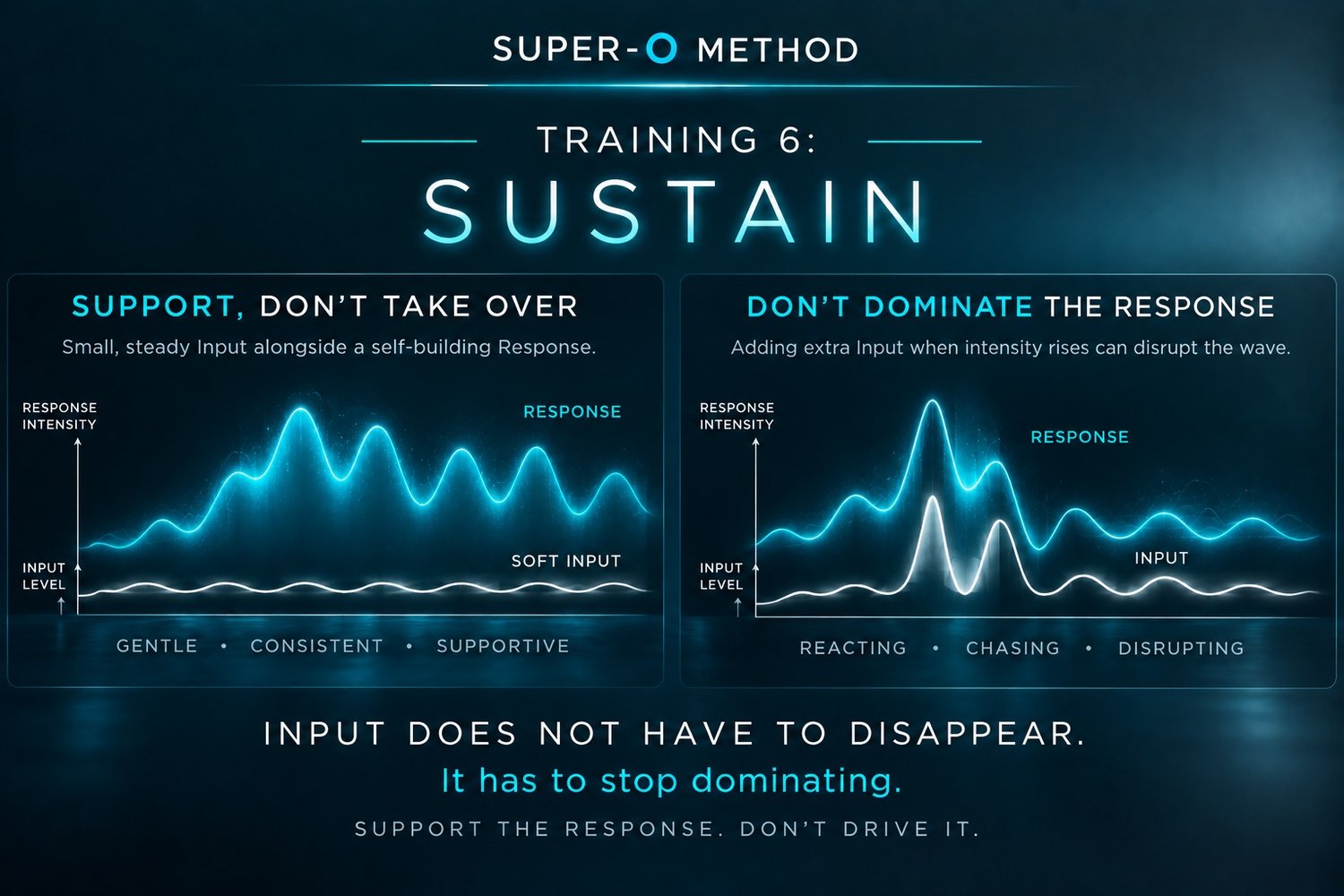
If gentle Input is supporting what is happening, there is no need to remove it simply because you think you should.
But when Response is carrying itself, resist the urge to add more, intensify what you are doing or repeatedly check whether Input is still needed.
Allow Input to soften — and, when appropriate, fade completely to zero.
Let Input become unnecessary. When Response can carry itself, let it.
Let Response change without trying to preserve it
By Sustain, Response may already be doing much of the work.
It may arrive as waves, involuntary contractions, spreading pleasure, sustained orgasmic activity or a Super-O that continues to change in character.
Your task is not to keep Response at its strongest point.
Let it rise. Let it fall. Let it become quieter. Let it gather again.
A change in Response does not necessarily mean that something has gone wrong or that you need to intervene.
Stay with the process rather than chasing the peak.
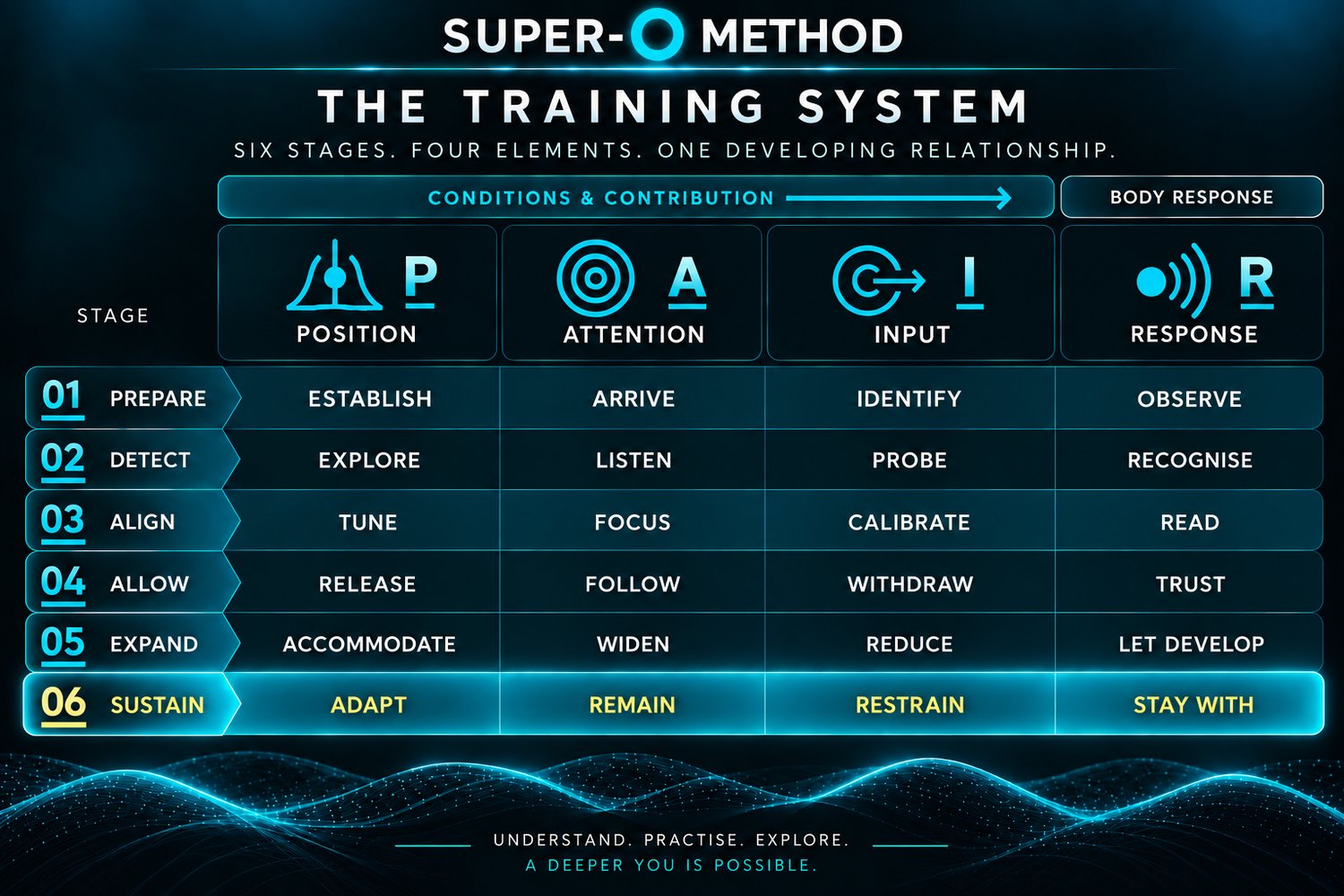
When Response changes, allow the other elements of PAIR to adapt around it rather than taking control of it.
As Response becomes more autonomous, more Input is not necessarily more useful.
A small amount may continue to support the experience — or Input may naturally soften until none is needed at all.
The important shift is to stop reacting to every rise in intensity by adding more.
Let Response determine what is needed.
Support it when useful. Leave it alone when it can carry itself.
The falling wave is still part of the wave.
Sustain is not about keeping pleasure at its highest point.
A Response may rise, peak, fall, become quiet and return. During a longer experience, this cycle may happen repeatedly — including within a Super-O.
The quieter periods matter because this is often where the urge to intervene appears.
You may want to increase Input, change Position or try to recreate what was happening a moment ago.
Instead, follow the Response through the change.
Let the peak fall. Let quiet be quiet. Stay receptive to whatever comes next.
Do not measure continuity by intensity.
The wave does not end simply because it falls.
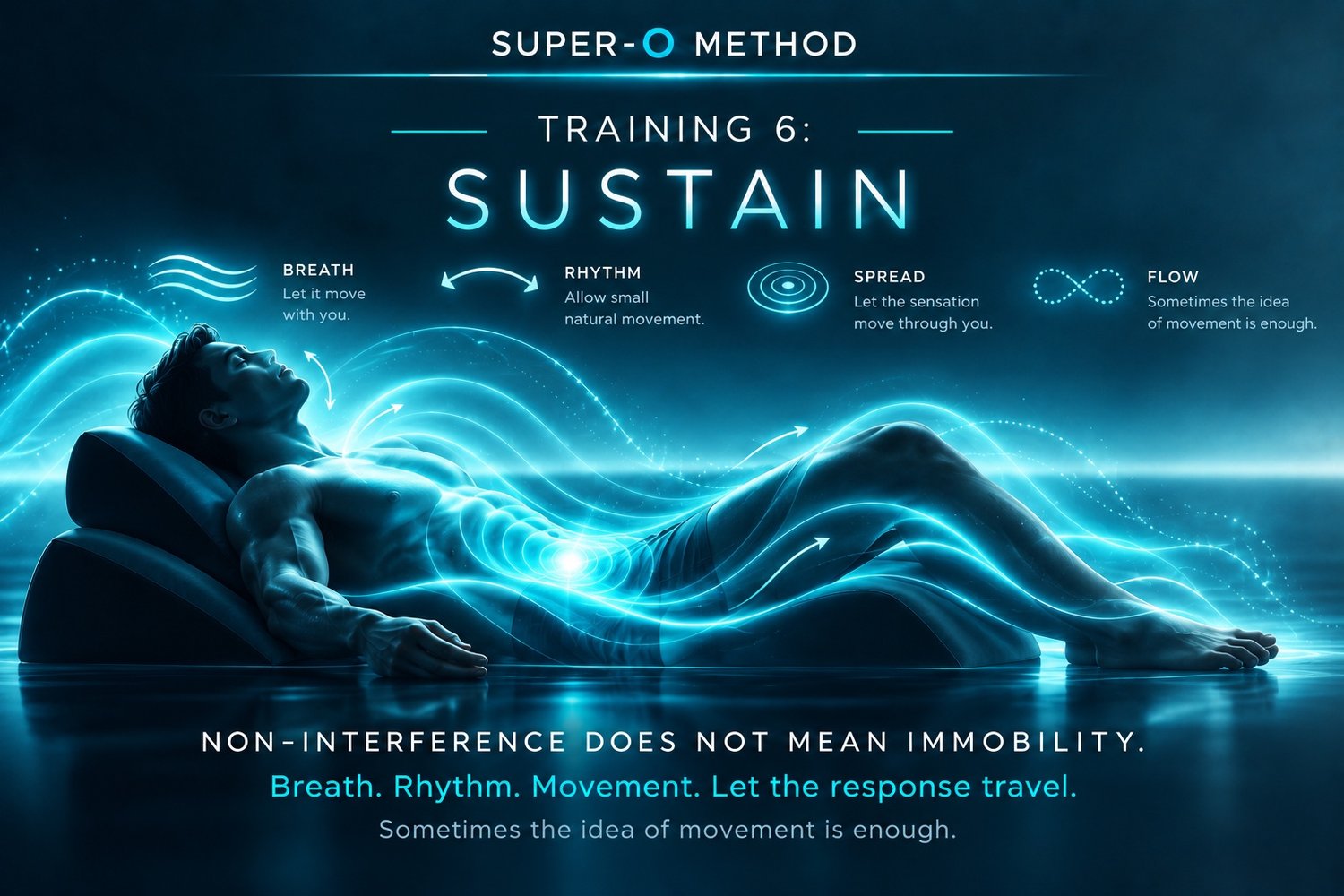
Non-interference does not mean immobility
As Response continues, your body may begin doing things you did not consciously plan.
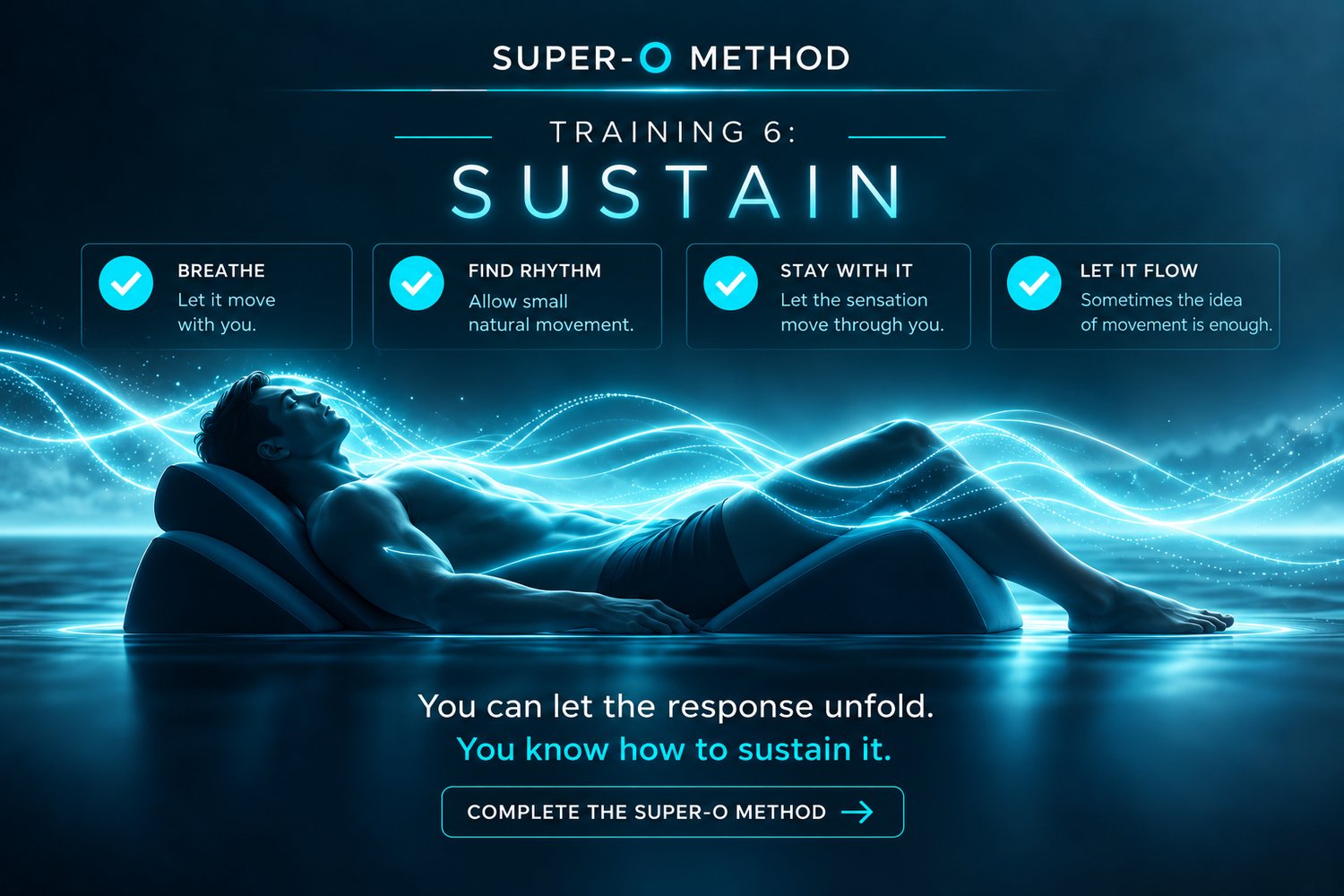
Breathing may change. Your abdomen or pelvic floor may move with the rhythm. Your head, legs or body may make small movements. Sometimes even imagined movement can seem to accompany what you are feeling.
You do not need to stop these changes simply because they are movement — and you do not need to deliberately create them either.
Let breathing remain comfortable. Let natural movement happen. If a small movement seems to support what is happening, allow it without turning it into another technique to perform.
Follow the rhythm that is already there.
You are not using movement to drive Response.
You are allowing movement to move with Response.
Don’t mistake change for loss
During sustained pleasure, Response may suddenly change character.
A rolling wave may become stillness. Strong contractions may soften into warmth. A concentrated sensation may spread through the body. Intensity may fall — or something completely different may take its place.
Even within a Super-O, there is no reason to expect one continuous state.
The instinct can be to compare what is happening now with what was happening moments ago — and then try to get the previous sensation back.
Instead, place your Attention lightly on the new Response.
Give it time before deciding that anything has been lost or needs correcting.
You are not trying to sustain one state.
YOU ARE SUSTAINING THE JOURNEY THROUGH THEM.
When it releases, you know why you came this far.
The journey towards a Super-O can take many forms.
There may be waves, contractions, spreading pleasure and moments where something seems ready to release but remains partly held back.
And then, when it fully unlocks, the experience can become extraordinary.
Pleasure may pulse through the pelvis and spread through the body in powerful, repeating waves. Sensation can seem to arrive from everywhere at once — building, releasing and building again without you having to manufacture it.
It can feel almost absurdly good: an overwhelming, immersive rush of pleasure that makes an ordinary orgasm seem like a very different kind of event.
This is the moment all that training in not interfering begins to make sense.
The Response is clear.
It is available.
It is unlocked.
And increasingly, it is unsupervised.
You are no longer trying to create the experience.
Your body is creating it — and you are inside it.
You have spent time with the Method learning how to stop getting in the way.
Now let Response show you how far it can go.
You do not need to take control back
When a Super-O releases, it can be tempting to react to the sheer intensity of what is happening.
You may suddenly start thinking about how to keep it going, recreate the last wave or prevent the experience from fading.
But the principles that brought you here still apply.
Let Position support you. Keep Attention lightly with the experience. Allow Input to remain minimal or disappear completely. Let Response continue to lead.
Waves may surge, recede, change character and return. Your body may move, contract or become remarkably still.
There is nothing you need to preserve.
A Super-O does not need supervising simply because you have noticed it.
Let the experience continue for as long — and in whatever form — Response chooses.
When a pleasure wave develops, resist the temptation to focus only on its strongest point.
Follow the complete shape:
Rise → Peak → Fall → Quiet → Return
As intensity falls, keep Attention lightly with whatever remains. Do not immediately add Input or try to recreate the peak.
If another wave develops, follow that one too.
The practice is staying with Response through the entire cycle — not keeping it at the top.
Begin with whatever gentle Input is already supporting the Response.
Once Response feels established, reduce the Input slightly.
Wait and observe.
If Response continues, soften again. Keep reducing until you discover how little deliberate Input is actually required — potentially allowing it to reach zero.
If Response continues without you, leave it alone.
If it begins to fade, you can introduce a small amount of Input again and observe what happens.
This is not a test of whether you can remove Input completely.
You are discovering the point at which Response no longer needs your help.
When Response develops a rhythm of its own, notice what else begins to move with it.
Your breathing may change. Your abdomen or pelvic floor may respond. Small movements may appear elsewhere in the body.
Rather than deliberately creating a rhythm, let yourself fall into the one that is already there.
Experiment with allowing your breathing or tiny natural movements to accompany Response without trying to lead it.
Then soften your involvement again and see what continues.
Move with Response. Don’t make Response move with you.
When Response changes state, notice your first reaction.
A strong wave may soften. Contractions may become warmth. Sensation may spread, become quieter or suddenly take on a different character.
Notice any urge to fix the change by increasing Input, changing Position or searching for the sensation that was there before.
Instead, place Attention lightly on what has replaced it.
Give the new Response time to reveal itself before deciding whether anything needs to change.
Do not try to return to the previous state.
The practice is learning to stay with Response as it becomes something else.
Sustain can be explored long after the first Super-O arrives.
The Further Drills explore quieter periods, autonomous continuity, changing states and small experiments that can help you understand how your own Response behaves over longer experiences.
Use them to experiment — not to give yourself more things to manage.
You’ve reached the end of the six-stage training — but the Method isn’t finished.
There is still so much we don’t know about how different people discover and experience the Super-O.
Your experience can help us learn.
Stay connected. Share what you discover. Help shape what comes next.