TROUBLESHOOTING
WHEN THINGS DON'T WORK AS EXPECTED
A practical guide to understanding what is happening in your sessions — and what to adjust next.
Most difficult sessions are not failures.
Something simply isn't lining up yet.

A practical guide to understanding what is happening in your sessions — and what to adjust next.
Most difficult sessions are not failures.
Something simply isn't lining up yet.
Not every difficulty has the same cause.
You might feel very little, struggle to recognise a Response, or find that promising sensations suddenly disappear.
Each of these experiences offers clues about what may need adjusting.
The key is to recognise your pattern before trying to change it.
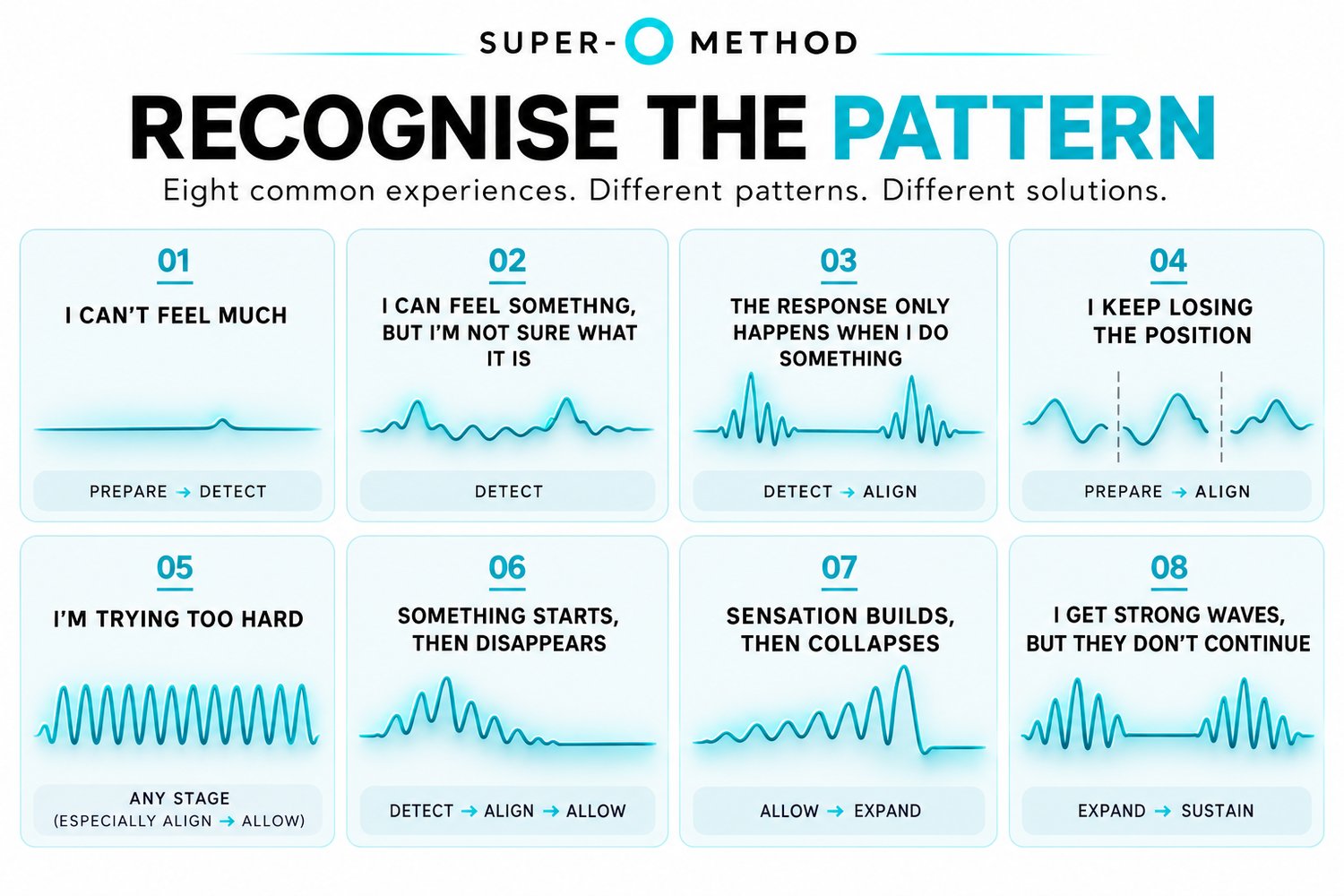
Explore the eight common patterns to find the guidance most relevant to you.
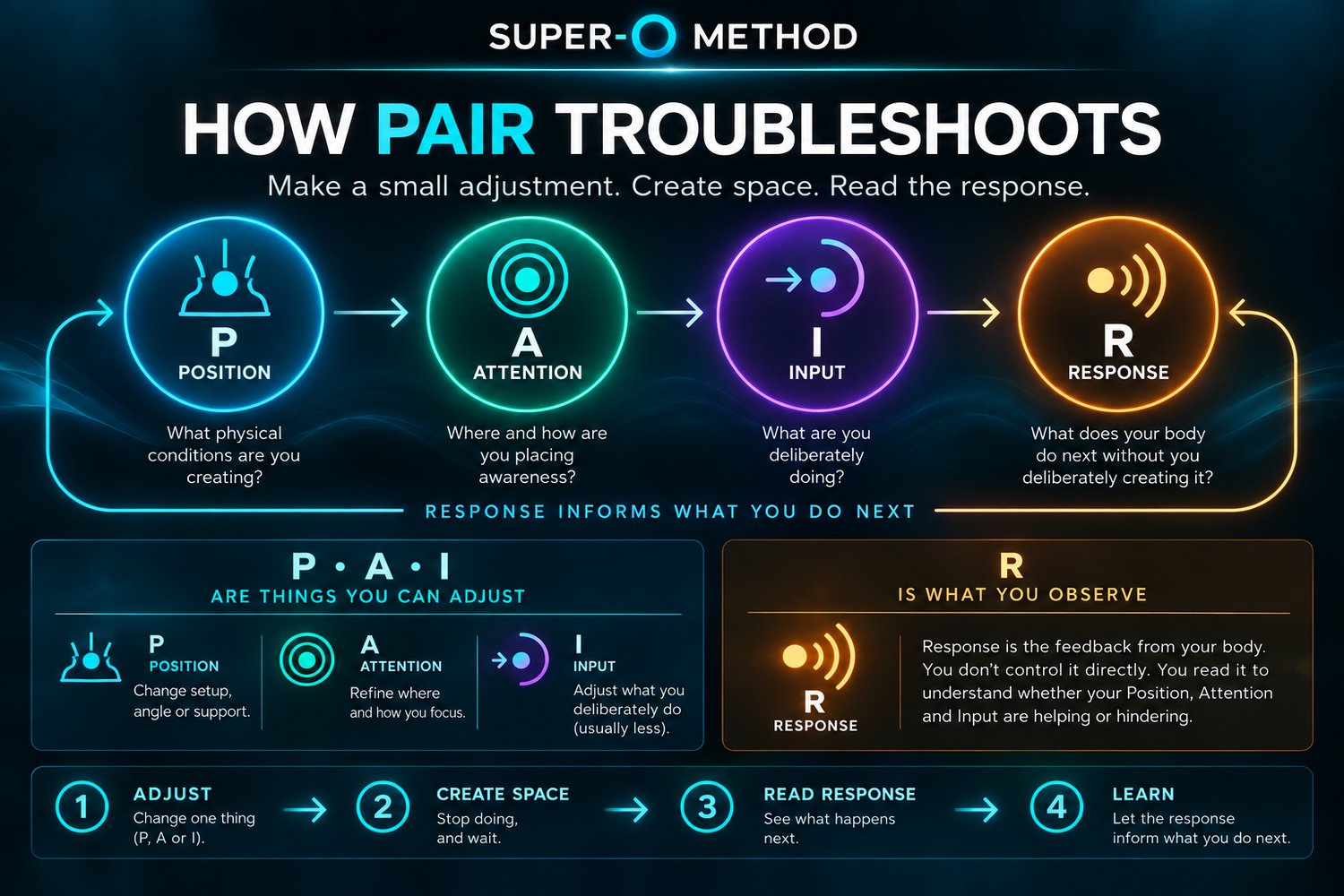
PAIR helps you understand why a particular pattern might be happening.
Position, Attention and Input are the three things you can adjust.
Response is what your body does in return — and your most useful source of feedback.
Change one thing at a time, then notice whether Response becomes clearer, weaker or remains unchanged.
Let Response guide your next adjustment, rather than trying to force a result.
There may be almost no internal sensation.
Or something is present, but it's too faint or ambiguous to recognise clearly.
At this stage, the objective isn't to produce powerful pleasure. It's to create conditions in which a small signal can become detectable.
P — POSITION
Is your setup comfortable and stable? Are you getting useful internal contact without constantly repositioning?
Small changes in angle, support or pelvic position may help.
A — ATTENTION
Are you giving subtle sensations enough time to emerge?
Notice differences rather than searching for intensity: warmth, pressure, tingling, fullness, faint pulsing or an area that feels different from its surroundings.
I — INPUT
Is your deliberate activity masking what happens afterwards?
Experiment with a little less Input and leave space to observe. If the signal remains absent, a small change in Input may also be worth exploring.
R — RESPONSE
When deliberate Input stops, does anything remain?
Does a sensation return after a delay, change character or develop without further activity?
There may be very little to observe initially. That is useful information, too.
Something is happening.
Perhaps a faint pulse, warmth, pressure, twitch, tingling or internal movement.
But you cannot tell whether you are creating it yourself or whether something is beginning to happen independently.
This uncertainty is part of learning. You do not need to classify every sensation immediately.
P — POSITION
Once you have a promising setup, give it time. Avoid continually searching for something better.
A — ATTENTION
Notice the sensation without interrogating it.
You are learning what the signal feels like, not trying to prove that every sensation represents progress.
I — INPUT
Create a clear separation between deliberate activity and what happens afterwards.
INPUT → SPACE → RESPONSE
Make a small deliberate contribution. Then stop and observe.
R — RESPONSE
What happens in the space?
Does anything continue, return, change or develop?
The gap helps you distinguish what you deliberately did from what happened next. This is a useful observation, although it cannot always establish exactly what caused a sensation.
→ THE BODY
→ ATTENTION WITHOUT INTERFERENCE
You contract — sensation appears.
You move — sensation appears.
You stimulate — sensation appears.
But when deliberate activity stops, the sensation stops too.
You have identified an Input that creates sensation. The next question is whether that Input can support a Response that becomes less dependent on continuous deliberate activity.
P — POSITION
Can your Position maintain useful contact without continual movement?
A — ATTENTION
Can you remain aware of the sensation after Input stops, rather than immediately trying to recreate it?
I — INPUT
Explore the minimum amount of Input needed to produce a recognisable sensation.
Experiment with its strength, frequency or duration.
Then leave space.
The objective is not necessarily to eliminate Input. It is to understand its relationship with Response.
R — RESPONSE
Does anything continue briefly after Input stops?
Does it return later, change rhythm or become less obviously connected to what you deliberately did?
Compare what happens with different amounts of Input.
If Response remains entirely dependent on deliberate activity, that tells you where your current training needs attention.
Something feels promising.
Then it disappears.
You adjust. Something else appears.
You adjust again.
Soon you are searching continuously and no longer know which change produced what.
This is primarily a problem of establishing and recognising repeatable conditions.
P — POSITION
Return to a stable, comfortable setup.
Use support where necessary. Make smaller adjustments and change one thing at a time.
A — ATTENTION
Give each adjustment enough time to evaluate before making another.
Notice where sensation becomes clearer, rather than constantly searching for greater intensity.
I — INPUT
Remember that repositioning is itself Input.
Constant movement makes it harder to distinguish the effects of Position from those of deliberate activity.
R — RESPONSE
Let Response inform you whether an adjustment was useful.
Did sensation become clearer?
Did something begin to pulse?
Did a signal persist once you became still?
Or did the movement simply produce another temporary sensation?
You are not searching for a mythical perfect millimetre.
You are looking for a Position that supports useful Response.
You are concentrating intensely.
Contracting. Adjusting. Controlling your breathing. Checking constantly.
Trying to recreate a previous experience.
Trying to make the next thing happen.
The session begins to feel like work.
This can happen at any stage, although it becomes particularly relevant when you are learning to allow an emerging Response to continue.
P — POSITION
Once Position is comfortable and providing useful contact, stop continually improving it.
A — ATTENTION
Attention does not need to become effort.
Stay interested without mentally gripping the sensation or repeatedly checking whether you are progressing.
I — INPUT
Ask yourself:
What am I doing that I could stop doing?
Experiment with removing unnecessary contractions, movements or corrections.
You may also notice unnecessary tension in the jaw, abdomen or pelvic floor.
R — RESPONSE
What remains when you reduce unnecessary activity?
Perhaps Response becomes clearer or continues.
Perhaps it becomes quieter.
Perhaps nothing changes.
Each outcome helps you understand whether your previous level of Input was useful.
Doing less is not abandoning the session.
It creates room to discover what happens without unnecessary intervention.
→ ATTENTION WITHOUT INTERFERENCE
A pulse appears.
Warmth develops.
A rhythm begins.
Pleasure may start building.
Then it fades.
The immediate temptation is to move, contract, adjust or try to bring it back.
But a pause does not automatically mean the process has ended.
P — POSITION
Did Position actually change?
If not, you may not need to move.
A — ATTENTION
Can you remain aware without searching anxiously for the missing sensation?
I — INPUT
Be careful of filling every quiet period with additional Input.
Experiment with waiting before making another adjustment.
If the quiet period continues, a small, deliberate change may be appropriate.
R — RESPONSE
Watch what happens next.
A pulse may return. Something different may emerge. Or the session may simply remain quiet.
Notice whether the original Response faded before or after you intervened.
This distinction may help you recognise when an adjustment is useful and when it is unnecessary.
A pause is not necessarily a problem to solve.
Give Response time before deciding what to change.
→ ATTENTION WITHOUT INTERFERENCE
→ THE SUPER-O JOURNEY OVER TIME
This is different from a faint Response simply fading.
Something is clearly building.
Pleasure increases. Pulses strengthen. The experience becomes more active.
Then, sometimes just as you recognise how strongly it is building, the Response suddenly flattens or disappears.
The important question is what changed immediately before the collapse.
P — POSITION
If Position is supporting the build, preserve it.
A change in intensity does not automatically require a change in Position.
A — ATTENTION
Notice whether attention tightens as intensity rises.
You may suddenly begin monitoring, anticipating or chasing what comes next.
Return to what is actually happening.
I — INPUT
Rising sensation is not automatically a request for more Input.
Watch for the urge to contract harder, move more or otherwise help.
Sometimes less Input is useful. At other times, a small amount of continued Input may support the Response.
Let observation guide that distinction.
R — RESPONSE
Look at what happened before the collapse.
Was Response becoming stronger, more rhythmic or more widespread?
Did it change before you reacted?
Or did it change immediately after you altered Position, Attention or Input?
One observation cannot establish the cause, but recurring patterns may reveal useful relationships.
→ ATTENTION WITHOUT INTERFERENCE
Response is no longer subtle.
Pleasure waves may be obvious.
There may be strong pulsing, changes in breathing, internal movement, spreading sensation or periods of intense pleasure.
But the Response repeatedly reaches a certain level and then breaks apart.
This is different from being unable to detect anything.
You already have substantial Response. The question is how to support its continuation without imposing unnecessary control.
P — POSITION
If Position is working, preserve the conditions supporting Response.
Avoid unnecessary correction.
A — ATTENTION
Follow Response without gripping onto it.
Let attention stay with what is actually happening rather than anticipating the next wave.
I — INPUT
As autonomous Response strengthens, deliberate Input may become smaller.
Sometimes it may become unnecessary.
Do not maintain Input simply because it helped you reach this point. Equally, do not remove useful Input merely because you believe you should be doing nothing.
R — RESPONSE
Let Response inform your decisions.
It may rise, flatten, pulse, pause, return, spread or intensify.
Look for patterns in what supports continuity and what appears to interrupt it.
Strong involuntary movement is not required. Response may also be experienced as changes in pleasure, sensation or internal rhythm.
Follow what is happening.
Rather than deciding what should happen next.
Sometimes the difficulty isn't one particular sensation or Response. It may be how you're approaching the session as a whole.
If the eight patterns haven't helped you identify what's happening, these deeper resources may offer a different perspective.
Explore deeper explanations, specialist topics and the questions we're still investigating.
Have you considered guided audio?